Top ReactJS Trends to Watch in 2026: What’s Next 

Home

Top ReactJS Trends to Watch in 2026: What’s Next 

Top ReactJS Trends to Watch in 2026: What’s Next 

Join our Newsletter!

ReactJS Trends 

If you have any interest in web development, you have likely seen how everything is evolving. Developers are examining better ways of implementing new interfaces that deliver a better experience to their users. As the demand for fast, reliable interfaces is continually increasing, it’s increasingly vital to keep up with the evolving ReactJS trends. By establishing these foundations within yourself, you will be able to develop and apply smarter development choices soon.

With each successive year, ReactJS continues to develop and create outcomes in how modern applications are designed. The updates, tools, and ideas that make up the ReactJS universe are forcing developers to think differently and advance the way they work. These changes aren’t just technical; they also reflect what users expect from digital experiences. Knowing what’s gaining attention and where the focus is shifting can give you an edge, right? So, in this blog, we will look at the best ReactJS trends to watch in 2026. Let’s dig in!

Want to stay ahead with the latest ReactJS trends? Our ReactJS development services can help you create modern, scalable, and future-ready applications, designed as per your business requirements.

Evolution of ReactJS

Since it was first implemented in 2013, React has changed the frontend development space through its component structure and virtual DOM. In earlier versions of React, we had JSX and rendering efficiency, which all led to building scalable user interfaces. Newer versions (React 15 and 16) further refined the usability of the library through performance improvements, error boundaries, and server rendering, and in the process, significantly improved development stability and experience. Meanwhile, React 17 through 19 introduced further original ideas and modern development workflows.

With React 17, we saw improvements to the upgrade paths of React and compliance with the browsers, while React 18 gave us concurrent rendering, new powerful hooks, and React 19 built on React 18 with server components, action-based state management, and support for Web Components. React continues to evolve to meet the needs of web development.

Must Read: ReactJS Web Development 

Upcoming Features in ReactJS

ReactJS 19 is the latest version, bringing fresh improvements to the way developers build user interfaces. With ReactJS’ upcoming features, version 19 focuses on better performance, cleaner code, and easier state handling. These updates mark a big step forward in the future of ReactJS and give a clear view of what’s new in ReactJS in 2026.

Upcoming Feature in ReactJS

1. Enhanced Hooks

One of the React 2026 updates includes powerful new hooks that will make state and effect management even smoother. These enhanced hooks aim to simplify logic and reduce repetitive code in components. They’re designed to give developers more flexibility and control in modern web development.

2. React Compiler

React is introducing a new compiler that optimizes code during build time. It helps reduce manual work by automatically improving performance behind the scenes. Instagram is already using this tool, making it one of the most promising ReactJS features.

3. Server Components

React now supports server components, allowing parts of the UI to render on the server. This feature works well with frameworks like Next.js and helps improve app performance. It reduces the JavaScript sent to the browser, making pages load faster.

4. Web Components Support

React will soon support the direct use of web components inside your code. This opens the door to combining different front-end technologies in one project. It’s a big step forward in creating flexible and reusable UI elements for modern web development.

5. Document Metadata

React 2026 updates will include better control over document metadata like titles and meta tags. This allows developers to manage SEO-related data more efficiently within their components. It saves time and keeps everything organized in one place.

Want to ensure your digital products stay competitive as new react trends shape the future of web development? Discover how the latest React roadmap helps business owners plan smarter, more future-ready tech investments.

What are the Top ReactJS Trends for 2026?

The React ecosystem is going through major improvements that are changing the way developers approach front-end development. ReactJS trends 2026 highlight a shift toward more efficient workflows, faster rendering, and cleaner architecture. With smarter tools and updated features, we can see how ReactJS is evolving in 2026 to meet the growing demands of modern web development.

ReactJS Trends 

1. Server Components in Action

React’s new server components allow parts of the UI to be rendered on the server, reducing the workload on the browser. This makes applications faster and easier to manage, aligning with the latest ReactJS trends. They also allow developers to send less JavaScript to the client, improving performance. This results in faster initial page loads and a smoother user experience.

2. Advanced Concurrent Features

React’s concurrent features, like Suspense and automatic batching, make multitasking smoother and interfaces more responsive. This update improves how React handles rendering without blocking the user experience. It helps manage large-scale applications more efficiently. Developers can build interfaces that stay fast even during heavy updates.

3. Improved Developer Experience

Tools like React DevTools are being enhanced to support more efficient debugging and testing. These improvements help streamline development workflows and reduce troubleshooting time. Developers get better visibility into component behavior and performance bottlenecks. This leads to quicker bug fixes and smoother iterations.

4. TypeScript Integration

The adoption of TypeScript continues to grow as teams seek more scalable and maintainable codebases. This is now a major trend in front-end trends 2026, supporting safer and more reliable coding. TypeScript’s static typing reduces runtime errors and improves code clarity. It also makes collaboration easier across large development teams.

5. Advancing React Native

React Native updates are making it easier to develop high-quality cross-platform apps. It remains a strong choice for teams working across both web and mobile interfaces. New libraries and tools are being introduced to improve development speed. These updates also enhance native-like performance and UI consistency.

Want to be sure that your web application delivers a fast and smooth user experience that keeps customers engaged? Discover how improving React performance can directly enhance satisfaction and boost overall business results.

6. AI-Powered User Interfaces

React is being used to build smarter, AI-driven interfaces that adapt to user behavior in real time. These features support more personalized and predictive user experiences. AI integration helps applications anticipate user actions and deliver relevant content. This enhances engagement and boosts user satisfaction.

7. Enhanced Performance Optimization

Performance remains a top focus, with React adding better support for edge computing and efficient memory handling. These updates are critical to meeting modern speed and scalability demands. They ensure faster content delivery across global networks. Optimizations also help reduce power and data usage on devices.

8. Web3 Integration

React is being adapted to work smoothly with decentralized technologies like blockchain wallets and smart contracts. This is part of the broader movement in JavaScript frameworks 2026 towards Web3-ready solutions. It simplifies the process of building secure and decentralized apps. React’s flexibility supports fast adoption in emerging blockchain-based platforms.

9. Faster and Smarter Toolchains

Modern tools like Vite and frameworks such as Next.js and Gatsby are becoming more powerful. These enhancements reflect improvements seen across React front-end development practices. They reduce build times and make testing and deployment more efficient. Developers benefit from improved hot reloading and modular workflows.

10. Community-Led Progress

The React ecosystem continues to expand thanks to open-source contributors who build tools, libraries, and new practices. These efforts keep ReactJS trends moving forward with fresh ideas and evolving standards. Active community support ensures regular updates and fast issue resolution. It also helps spread knowledge and best practices across the industry.

Want to scale your application seamlessly as your customer base grows? Learn how the benefits of ReactJS development services make large-scale, high-traffic apps easier to maintain and expand.

Are You Looking Forward to Embracing the Future of ReactJS?

ReactJS trends are reshaping the landscape of modern web development. With fresh tools, smarter architecture, and growing support for cutting-edge features, staying current is no longer optional. Developers who stay informed can build faster, smarter, and more scalable applications. Understanding these shifts puts you in control of how you approach digital solutions in 2026 and beyond.

At Mindpath, we offer expert ReactJS development services designed for growth and scalability. Our team stays aligned with the latest ReactJS trends, ensuring your product is future-ready. From concept to deployment, we develop efficient and high-performing applications tailored to your goals. Partner with us to unlock seamless, modern interfaces built with precision and care.

Frequently Asked Questions

1. Which ReactJS trends in 2026 should development teams prioritize for immediate implementation?

Server components and TypeScript integration deliver the most immediate practical value. Server components reduce browser workload and improve page load speeds noticeably, while TypeScript adoption reduces runtime errors and improves long-term code maintainability. Teams that implement both together consistently report faster development cycles and significantly fewer production issues across complex applications.

2. How do React server components actually differ from traditional client-side rendering?

Traditional client-side rendering sends all JavaScript to the browser, which then builds the interface. Server components render parts of the UI on the server before delivery, sending less code to the browser entirely. The result is faster initial page loads, reduced bandwidth consumption, and noticeably improved performance especially on lower-powered devices and slower connections.

3. Is TypeScript adoption in ReactJS projects worth the additional learning curve for teams?

For most teams, absolutely. TypeScript catches errors during development rather than at runtime, which prevents costly debugging sessions after deployment. Larger teams benefit especially from improved code readability and collaboration. The initial learning investment typically pays back quickly through fewer bugs, cleaner architecture, and significantly easier onboarding of new developers joining existing projects.

4. How is AI integration changing the way ReactJS applications are actually built and experienced?

AI integration allows React applications to adapt dynamically to individual user behavior, delivering personalized content and anticipating actions in real time. Beyond user experience improvements, AI-powered development tools are also accelerating the coding process itself. Developers using AI assistance within React workflows report meaningful reductions in repetitive coding tasks and faster overall delivery timelines.

5. Will Web3 integration in ReactJS become mainstream for standard business applications anytime soon?

It is gaining momentum but remains specialized for now. Businesses in finance, gaming, and supply chain are actively exploring React-based Web3 applications involving blockchain wallets and smart contracts. For mainstream business applications, adoption will depend heavily on regulatory clarity and user familiarity with decentralized technologies. Developers building familiarity with Web3 tools today will hold a clear competitive advantage tomorrow.

Related Post

Benefits of agile methodology

Approaching software development without a flexible mindset can often result in delays and stress. This is where the benefits of agile methodology come into play. Agile allows a team to react quickly to change, provide value continuously, and maintain common goals. Agile fosters teamwork, quick delivery, and incremental updates. If you ever find that you are constantly feeling stuck or that things are moving too slowly, then Agile can provide a steady flow that will keep things moving forward and adjust its plans accordingly.

Agile offers structure while maintaining flexibility. Project work is broken down into smaller bits and allows for feedback and change along the way. This helps keep developers, testers, and clients engaged through the process. People can track progress more easily and receive results faster. Agile doesn’t just focus on completing tasks, but on building something useful at every step. This blog highlights some of the primary benefits of Agile that many of today’s teams prefer to embrace.

Explore how custom software development services using agile methodologies elevate your business performance. Reach us at Minpath, and we will provide expert guidance to you every step of the way.

What is Agile Methodology?

Agile methodology is an adaptive and collaborative method of software development based on the principles set forth in the values of the Agile Manifesto. Agile focuses on teamwork, the ability to adapt, continuous improvement, and the delivery of working software in small, manageable pieces. An agile team is self-organized and can adapt quickly to changes during the development life cycle. So, what is the main objective of agile methodology? It is to be responsive and provide value more quickly.

Agile focuses on helping teams select tools and techniques for their goals rather than abiding by a single standardized process. Each project can look a little different, but they all follow the same Agile principles by planning in short iterative cycles, soliciting feedback, and adjusting from there. Ultimately, Agile allows teams to deal with uncertainty during a project in order to improve at every turn.

Also Read: Types of Software Development

Types of Agile Methodologies

Agile provides several methodologies that adhere to its fundamental principles; however, they differ in structure and practice. Each is intended to foster teamwork, speed, and flexibility in its own unique way.

Types of Agile Methodologies

1. Crystal

Crystal is a lightweight agile methodology that encourages rapid delivery of working software, communication with customers, reducing risks, and frequent releases. It is flexible with respect to team size and project complexity, and it promotes collaboration and communication to improve team and customer feedback.

2. Scrum

Scrum is a prescribed agile framework that arranges work into fixed-length sprints, which allow the team the opportunity to inspect how much work was done so far and adjust based on that. The goal is to enhance visibility, facilitate some level of collaboration consistently, and have continuous improvement as the team works through it with prescribed roles and ceremonies.

3. Kanban

The kanban approach is concerned with delivering work continuously and has a strong lean focus on improving the process. The visual workflow helps teams find bottlenecks, work on reducing cycle times, and allows managing work to be simplified using boards and cards.

4. Lean

Lean focuses on maximizing customer value by eliminating waste and improving efficiency throughout the development process. It supports fast delivery, strong team collaboration, and quick response to feedback.

5. Scrumban

Scrumban fuses the structured planning of Scrum with the visual task management of Kanban to allow flexible value-based delivery. It is an adaptable and process-focused method that allows teams to incorporate regular updates, rapid releases, clear task ownership, and adaptability as project needs change.

Wondering how Agile practices fit into the bigger picture of building high-impact web applications, our web app development roadmap outlines the full step-by-step journey from planning to deployment.

Top Benefits of Agile Methodology

Agile provides a modern approach for the management of software projects, which is focused on flexibility, collaboration, and rapid delivery. Here are some important agile software development benefits that aid teams in creating better products with better timeliness.

Top Benefits of Agile Methodology

1. Customer-Centric Results

Agile methodologies promote regular feedback and involvement from customers in every aspect of development, leading to products that can be tailored to more accurately fit the needs of the user. One of the key agile software development advantages is that this increases customer satisfaction (as perceived by customers during development) and trust moving forward.

2. High-Quality Deliverables

With every sprint of work teams are testing and improving their work. You will note that the ongoing improvement is one of the key benefits of agile software development, and it helps teams develop stable and reliable products. Solving problems early is part of the workflow.

3. Flexibility to Change

Agile teams can quickly adjust plans in response to new feedback or ever-changing goals, and ease of change is one of the greatest strengths of agile software development. The essence of agility is the ability to stay aligned with business needs without spending unnecessary time or going off track.

4. Clearer Planning and Estimations

Agile operates within short, structured cycles, which allow for considerably improved estimation of timelines and budgets. This is one of the most important benefits of agile software development, especially for project managers whose primary goal is to solicit the meters for project planning in the most effective way possible. Predictable progress encourages smarter decisions.

5. Reduced Development Risks

Frequent reviews and updates allow teams to catch issues early when they are still not serious problems. This built-in risk control offered by agile is of major benefit to agile project success. Agile provides full visibility into work progressing at all times.

6. Stronger Team Collaboration

Agile encourages daily stand-ups, a routine dialogue, and real-time feedback/updates. This collectively helps with teamwork, collaboration, and confusion regardless of role. Better communication is one of the fundamental advantages of agile methodology and contributes to an easier, smoother project flow.

Want to know how businesses turn ideas into scalable software solutions? Explore the custom software development process and the role Agile plays in efficient execution.

Ready to Embrace the Agile Advantage?

Agile has changed the way modern teams build software by promoting collaboration, speed, and flexibility. The benefits of agile methodology include higher customer satisfaction, better product quality, reduced risk, and smoother workflows. By using short cycles and continuous feedback, Agile helps teams deliver faster, smarter, and with greater confidence, making it a preferred choice for many development teams today.

Want to apply these custom software development benefits to your next project? At Mindpath, we offer custom software development services built around proven agile methodologies. Contact us and our team will help you with clear communication, flexible planning, and faster delivery that meets your business goals. With Mindpath, you get tailored solutions that revolve around your business requirements and deliver long-term value with every sprint.

Frequently Asked Questions

1. Is Agile methodology suitable only for software development projects?

No, Agile is used in many industries beyond software development, including marketing, healthcare, education, and product management. Any team that needs flexibility, faster delivery, and continuous improvement can benefit from adopting Agile practices in their workflow.

2. How long does it take for a team to adapt to Agile?

The transition time depends on team size, experience, and project complexity. Some teams adapt within a few weeks, while others may need a few months to fully understand Agile practices and build a smooth collaborative workflow.

3. Can Agile work for large enterprise projects?

Yes, Agile works well for both small and large projects. Large enterprises often use scaled Agile frameworks to manage multiple teams while maintaining collaboration, transparency, and faster delivery across complex projects and departments.

4. What tools are commonly used in Agile project management?

Teams often use tools like Jira, Trello, Asana, and Azure DevOps to manage Agile workflows. These tools help track tasks, manage sprints, monitor progress, and improve communication between developers, testers, and stakeholders.

5. How does Agile improve communication between clients and development teams?

Agile encourages regular meetings, sprint reviews, and continuous feedback throughout the project. This keeps clients involved in decision-making, improves transparency, and helps development teams stay aligned with changing business expectations and project goals.

AI-driven legacy system modernization

AI-driven legacy system modernization is transforming how businesses approach aging technology. Firms are under increasing pressure to remain competitive and deal with complicated and old systems. Is it possible to make this process smarter with the help of technology? The dilemma is how to balance innovation and stability, and how several are looking at the active reformation of legacy workflow by AI and automation.

The adoption of smart solutions enables organizations to be agile and fast in integrating main systems. They are able to detect bottlenecks, minimize mistakes and streamline processes to a much greater accuracy. This solution triggers the debate of efficiency and future-proofing. In this blog, we will explore how AI and automation can bring the legacy systems up to date. Keep reading further!

Looking to future-proof your legacy applications with AI-driven solutions? Mindpath’s legacy modernization services help organizations upgrade systems efficiently and stay ahead in the digital landscape.

What is AI-Driven Legacy System Modernization?

AI-driven legacy system modernization is the use of artificial intelligence and machine learning to update, translate, and migrate outdated enterprise software into modern, cloud-native environments. It automates key activities such as code refactoring, documentation, and testing while identifying system dependencies and preserving core business logic without requiring high-risk “rip and replace” overhauls. This approach accelerates modernization, reduces errors, and lowers costs, helping organizations transition ageing systems into agile and cloud-ready infrastructure.

The adoption of AI in legacy modernization will allow decisions to be made more intelligently when upgrading the system. Machine learning suggests trends, risks forecasts and provides best optimized solutions. Generative AI can help generate proper code and documentation and minimal disruption. Through AI, organizations can modernize in a shorter time, continue working with the existing systems, and optimize them to grow in the future.

Must Read: Benefits of Modernizing Legacy Systems

Why AI-Driven Legacy Modernization Matters?

Old systems have been known to slack innovation and amplify risks in operation. These are the advantages of AI and automation in legacy system modernization.

1. Faster Modernization Cycles

AI-driven legacy system modernization speeds up system upgrades by automating repetitive tasks. Organizations accomplish projects in lesser time, downtime is minimized and efficiency enhanced.

2. Cost Reduction

AI maximizes the investment of the resources and reduces errors that reduce the expenses of the modernization. The process of legacy application modernization is predictable and more cost-effective.

3. Improved Accuracy

AI is very accurate in analyzing code and data which minimizes human errors. This makes sure that the updates do not affect business logic and system stability.

Must Read: Monolith to Microservices

4. Enhanced Security

Artificial intelligence-based devices identify threats immediately and indicate vulnerabilities. Companies enhance protection and comply successfully.

5. Scalability and Flexibility

AI allows legacy systems to manage increasing data and traffic. They are unified with modernization based on cloud, IoT, and advanced platforms.

6. Future-Proofing Operations

AI-driven legacy system modernization supports incremental upgrades, extending system lifespan while adapting to evolving technologies. This makes systems up to date and capable of future expansion.

Wondering how to balance AI innovation with a strong modernization plan? Discover the legacy modernization strategy to achieve a more effective transformation.

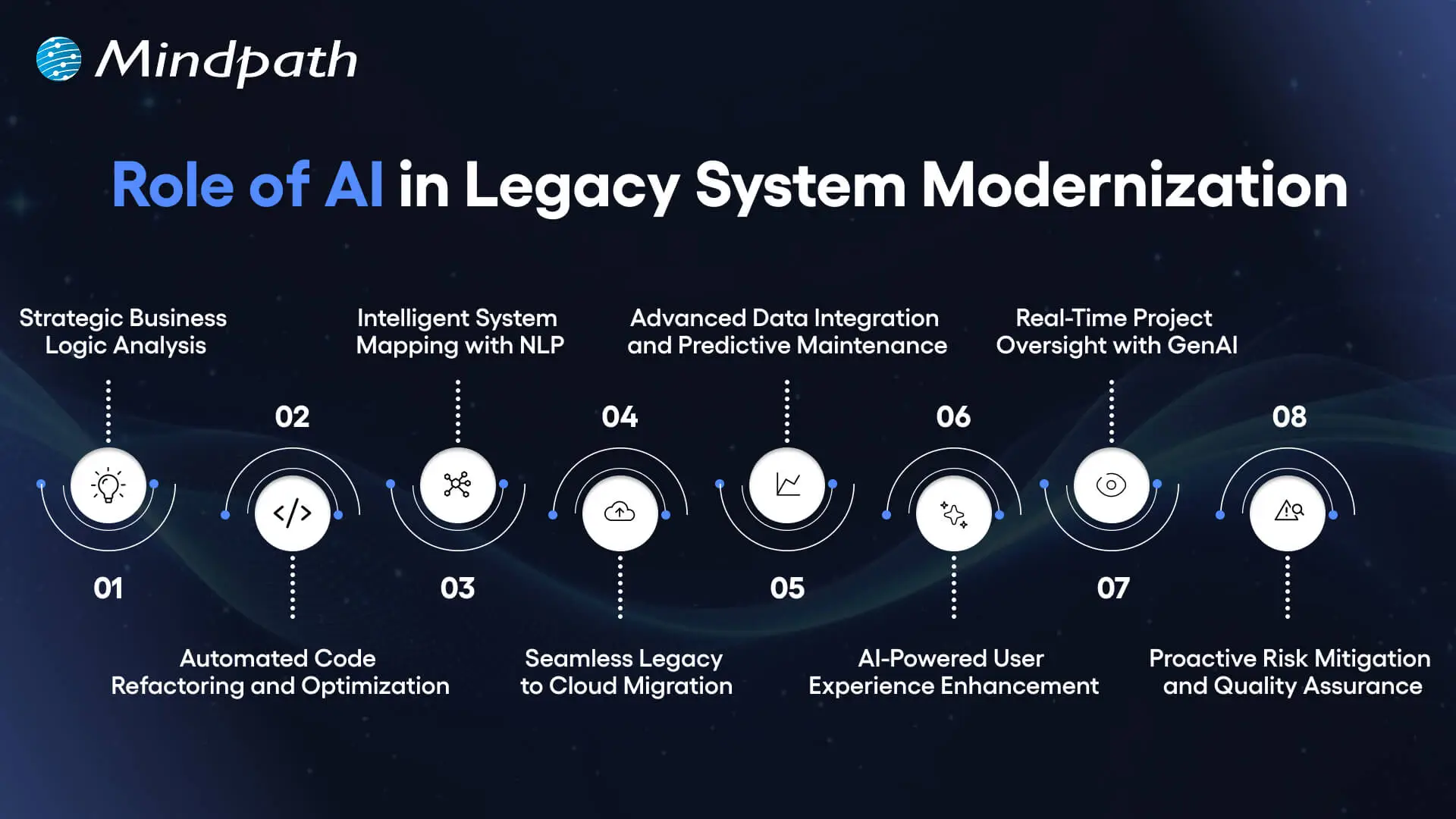
Role of AI in Legacy System Modernization

AI-driven legacy system modernization is reshaping how organizations update and optimize outdated systems. Here are the roles of AI-driven legacy system modernization in transforming legacy operations efficiently.

role of ai in legacy system modernization

1. Strategic Business Logic Analysis

AI-driven legacy system modernization starts by uncovering hidden business logic. It plots dependencies and decision rules. Modernization becomes smarter and data-driven, and teams are given a clear understanding.

2. Automated Code Refactoring and Optimization

AI rewrites the old code to new cloud-ready codes. Refactoring is faster, fewer errors in the system, and the system itself is much better with generative AI.

3. Intelligent System Mapping with NLP

Natural language processing transforms the complex old code into canned knowledge. Inefficiencies and bottlenecks are promptly found and assist in accelerating modernization.

4. Seamless Legacy-to-Cloud Migration

AI-driven legacy system modernization enables smooth cloud transitions. It also re-architectures code to reflect the current architectures and best practices.

Must Read: Benefits of Cloud Migration

5. Advanced Data Integration and Predictive Maintenance

AI integrates multiple sources of data to allow a smooth integration. Predictive analytics will identify possible problems before they happen and minimize downtime and operational problems.

6. AI-Powered User Experience Enhancement

AI interprets the user behavior in order to streamline interfaces. Chatbots and virtual assistants automate the repetitive field of work making it more engaging and efficient.

7. Real-Time Project Oversight with GenAI

AI offers invaluable real-time insight into the state of modernization. Predictive analytics and automated documentation keep the stakeholders updated and project on schedule.

8. Proactive Risk Mitigation and Quality Assurance

AI reduces the human factor and promotes uniformity. Modernization with structures and low risk can have safety nets that are provided through automated testing and monitoring.

Looking to create a clear path for modernization powered by AI and automation? Check out the legacy modernization roadmap to organize your approach effectively.

Ready to Transform Your Legacy Systems?

AI-driven legacy system modernization empowers businesses to update old systems quickly and accurately. It reduces errors, lowers costs, and improves performance. Companies gain clear insights into business logic and system dependencies, enabling smarter decisions. Modernization also ensures systems stay scalable, secure, and ready to support future growth efficiently.

Mindpath legacy modernization services help organizations implement AI-driven solutions smoothly. Our team analyzes existing systems, refactors code, and enables cloud integration. We provide predictive analytics, risk mitigation, and real-time monitoring. With our services, companies can modernize legacy systems efficiently while preserving core business logic and maintaining operational continuity.

FAQs

1. How does AI-driven legacy system modernization support business growth?

AI-driven legacy system modernization helps companies scale systems to handle more data and traffic. It ensures faster decision-making, improves performance, and keeps core business logic intact. Mindpath’s services guide businesses in adopting AI to modernize efficiently and support long-term growth.

2. Can my existing legacy system work with new technologies after modernization?

Yes. AI-driven legacy system modernization enables integration with cloud platforms, IoT, and modern applications. Mindpath’s legacy modernization services ensure your system becomes compatible with emerging technologies while maintaining stability and operational continuity.

3. How does modernization impact overall operational efficiency?

Modernization reduces manual work, shortens upgrade timelines, and minimizes errors. By applying AI-driven legacy system modernization, companies achieve faster operations, lower costs, and higher system reliability. Mindpath helps organizations implement these efficiency improvements effectively.

4. What technical steps are involved in AI-driven legacy system modernization?

AI maps business logic, automates code refactoring, analyzes dependencies, and predicts potential failures. Tools like generative AI and NLP convert complex legacy code into modern, cloud-ready formats. Mindpath applies these techniques to ensure smooth, accurate modernization.

5. How does AI help in risk reduction during modernization?

AI identifies vulnerabilities, monitors system performance, and flags potential failures early. AI-driven legacy system modernization reduces errors and ensures consistent updates. Mindpath’s services integrate these safeguards, creating structured, low-risk modernization projects.

Support Is One Click Away

Featured Posts

Related Post

How much does hiring a ReactJS developer cost? Learn about factors affecting rates, and how to find the best talent within your budget.