Lead Generation Chatbot: Automate Lead Generation and Sales 

Home

Lead Generation Chatbot: Automate Lead Generation and Sales 

Lead Generation Chatbot: Automate Lead Generation and Sales 

Join our Newsletter!

lead generation chatbot

Have you thought about the impact that a lead generation chatbot could have on attracting and engaging customers for your business? The benefits of chatbots are clear: Because these chatbots start conversations immediately, they create a welcoming experience that encourages visitors to leave their details. They make conversation feel fluid and natural, keeping prospects looking, listening, and engaged, without breaks. They can help you seize opportunities as soon as they arrive, ensuring no lead gets away, and usually bring a steady stream of interested prospects to your business.

In addition to just collecting contact details, these chatbots can also qualify a lead, figuring out their needs and pairing those needs with the appropriate solution. They can answer questions quickly, suggest services, and schedule meetings in real time. This efficient method saves time for your sales team while keeping the customer journey uninterrupted. Chatbots are automating lead management and personalizing lead management like never before. In this blog, we will take a closer look at their use cases.

Want to build a powerful chatbot tailored to your business needs? Mindpath’s custom chatbot development services will provide expert solutions to enhance customer experience and boost lead generation.

What is a Lead Generation Chatbot?

A lead generation bot is an automated conversational tool that engages visitors on your website or messaging apps, captures their contact details, and qualifies them as sales prospects in real time. Unlike static contact forms, it interacts naturally with visitors, asking thoughtful questions in a friendly tone, so no sales opportunity goes unnoticed while your business collects the information it needs.

A chatbot does not wait for visitors to do something like the outdated contact form. Its proactive behavior opens up the conversation and allows visitors to interact. A chatbot speaks to visitors instantly, answers questions, leads visitors to book a demo, or suggests the next step. Your chatbot can take information collected and send it directly to your marketing tools, so lead follow-up is fast and organized.

Looking to see how AI chatbots can boost your sales? Check out real-life examples of AI chatbots that increased conversions to discover strategies that truly work.

Benefits of AI Chatbots for Lead Generation

Lead bots are impacting how companies are collecting and converting potential customers through real-time interaction. Utilizing AI chatbots for lead generation allows for the quick acquisition of information while taking potential customers smoothly into the next step.

Benefits of AI Chatbots for Lead Generation

1. Expand Your Reach Across Channels

A lead generation chatbot can talk to prospects through your website, email, social media, and various messaging channels such as WhatsApp. You’re connected to customers on their most convenient platforms, and it makes it easy to have a conversation. The more dialogues you open across key communication points, the more customers will engage, putting you in a better position to convert a quality lead. When you utilize lead generation tools such as chatbots, your business remains prominent and accessible across all communications.

2. Boost Lead Conversion Speed

A sales chatbot AI can qualify prospects quickly and send them on to your sales team or follow-up system. With real-time engagement, you can respond to inquiries and gather needed information without delays. Which means that leads stay warm and are more likely to take action sooner rather than later. An AI chatbot for customer support can also help field questions that affect purchasing decisions, enhancing conversion rates even further.

3. Provide Consistent, 24/7 Engagement

A lead generation chatbot is available 24/7 and is able to engage with visitors when they show that they are serious about purchasing. Customers can get answers or help whenever they need them without waiting for store hours. This establishes trust with the customer and reduces the chances they will drop off during the purchasing process. This level of availability also strengthens connections with customers and the level of engagement overall.

Also Read: AI for Customer Services

4. Lower Your Cost Per Lead

Chatbot sales systems take away the manual and extra people that traditionally went into copy and qualifying leads, which will have a direct impact on chatbot pricing as more value is received for less money. Because of the efficiency of Conversational AI chatbot sales automation and how they scale, businesses won’t have to pay more to scale the amount of leads generated to scale resulting in every lead gained becoming progressively cheaper over time.

5. Scale Without Limits

By utilizing a chatbot for sales automation, businesses have the ability to manage hundreds of conversations simultaneously. This means you will never miss out on having a conversation with a potential customer, regardless of the demand, and your chatbot will operate seamlessly even during peak traffic and campaigns. Scalability like this means everything to growing businesses that want to take their reach to the next level.

6. Unlock Actionable Data Insights

A sales chatbot AI is able to collect in-depth insights around visitor behavior, intentions to buy, and preferences that can help improve your marketing campaigns and target customers more accurately. Captured custom chatbot analytics can inform more about which conversations converted into sales and why. Taking this data-driven approach, every single interaction, both now and in the future, improves through the method of practice.

Wondering how top businesses make smarter choices? Discover the importance of data-driven decision-making for businesses to drive growth and stay ahead.

How to Build Your Own AI Chatbot for Lead Generation?

Building a lead generation AI chatbot can help your business engage prospects, answer questions instantly, and collect valuable data automatically. With the right tools and strategy, you can create a chatbot that not only interacts with visitors but also converts them into potential customers.

Steps to Build Your Own AI Chatbot for Lead Generation

1. Plan and Design Lead Qualification

Define what a valuable lead means for your business before creating your lead generation chatbot. Plan key questions to qualify prospects and decide the follow-up steps, such as sending them to sales or booking meetings. Choose the platforms, like your website or WhatsApp, where the chatbot can engage the most visitors.

2. Integrate With Key Business Tools

Connect your chatbot to essential tools like CRM for tracking, email platforms for follow-ups, and scheduling tools for instant bookings. Use analytics to track performance and refine your strategy. Whether through custom or pre-built options, integrations make your chatbot a powerful automated sales AI bot.

3. Build a Strong Base

Plug-in solutions offer ready-made bot structures but limit customization. AI-powered platforms can set up your chatbot quickly with features that save time. A DIY build gives full control but requires more effort to create a flexible and high-performing bot.

4. Choose the Right Platform

Pick a platform with features like lead scoring, CRM integration, and multi-channel capabilities. Decide between coding, low-code, or no-code options based on your team’s skills. The right choice will help you create a reliable lead generation chatbot template that supports your goals.

5. Launch and Optimize Your Bot

Deploy your bot where it can have the most impact, such as your website or popular messaging apps. Start with a small audience to test and refine performance. Keep updating it to ensure your lead generation chatbot consistently delivers results.

Curious how chatbots understand and respond like humans? Learn what conversational AI is to see how it powers smarter lead generation and sales.

Looking to Build a Custom Chatbot for Your Business?

A lead generation chatbot improves the way businesses connect with potential customers. It engages prospects instantly, qualifies them effectively, and guides them toward the next step. With features like multi-channel reach, scalability, and data insights, it streamlines lead capture and boosts conversion rates while ensuring a smooth and professional customer experience at every stage of the interaction.

At Mindpath, our custom chatbot development services are designed to create solutions that match your business goals and enhance lead generation. We build chatbots that engage visitors, qualify leads faster, and integrate smoothly with your existing systems. With our expertise, you can deploy a chatbot that drives conversions, strengthens relationships, and supports your business growth effectively.

Related Post

Frontend and Backend

Creating a strong business application depends on an important understanding of how you connect the frontend and backend to develop a consistent experience for the user. Picture a user on a platform that is fast, responsive, and intuitive. At every click, scroll, and keyboard input, there are systems running in the background to simulate that experience, all while interacting with a framework and keeping the user interface interesting. Technology, in turn, must be aligned with user experience and growth expectations to ensure a platform operates without flaws while keeping users satisfied.

As businesses grow, the proportion of back-end and front-end becomes more important than ever. The front-end dictates the manner in which users experience your platform, while the back-end powers the processes that allow everything to run smoothly. Ensuring that the two work closely together enhances performance, increases efficiencies, and guarantees a consistent user experience. This blog outlines the ways that both frontend and backend can be used to build a scalable business application.

Ready to build an application that provides your business with a unique and secure digital presence from front end to back end? Mindpath offers expert full-stack development services to help you design and develop scalable web application.

What are Backend and Frontend?

Frontend refers to the section of an application that users notice and directly participate with. The front end includes everything users can see and all the visual and interactive elements that facilitate interaction with the application. Frontend developers use technologies such as HTML, CSS, or JavaScript, and frameworks such as React, Angular, or Vue.js to create interactive designs and usability of the platform.

The backend is the server-side component of an application that enables the frontend to function. The backend is responsible for data management, processing user requests, and ensuring that everything works correctly. Backend developers use programming languages such as Python, Java, PHP, or Node.js, along with databases such as MySQL, SQL, or MongoDB. The backend layer ensures that the application functions reliably and efficiently, delivering the information the frontend needs.

How Frontend and Backend Work Together for Building Scalable Applications

The front-end and back-end collaborate appropriately to manage both user actions and the appropriate background processes that will occur. This collaboration will promote the applications’ responsiveness and scalable properties for more users and maintain the performance expected by the user.

1. API Communication

One of the main methods by which the frontend and backend cooperate is through APIs such as REST or GraphQL. The backend thus offers the frontend certain endpoints from which it can get data or to which it can send data.

The frontend on its part performs HTTP requests like GET, POST, and PUT to communicate with these endpoints. Such a division provides a possibility for different teams to develop the UI and business logic separately and thus more efficiently.

2. Microservices Structure

In order to handle the complexity of huge applications, an option is to split the backend into several small units referred to as microservices. Each microservice is responsible for one specific area of the application, for example, payments, user accounts, or products.

The front-end and back-end interact with each other through APIs for every service, thus being able to work on different parts at the same time. This organizational pattern allows applications to become scalable and the process of development to be more efficient.

3. Asynchronous Communication

The frontend and backend have the ability to interact asynchronously, which contributes to a better performance. In a situation where a user makes a request that takes a long time, the front end is able to give an immediate response to the user.

The backend is handling the request silently and when it is done, it sends a message to the frontend. This method is free from the problem of users having to wait for a long time and their experience is thus made better.

4. Efficient Data Handling

The data that is being transferred from the frontend to the backend and vice versa must be of the highest standard in terms of speed and efficiency. The backend is to send only the necessary data to the frontend, thus lessening the network or bandwidth usage.

One of the ways through which it is possible to load large datasets of records into small pieces is pagination. The use of JSON or some other lightweight formats is the way to shorten the response times.

5. Independent Scaling

Apps work better when the frontend and backend are allowed to scale separately as per their requirements. In such a case, the front-end servers will be able to deal with the increased traffic without inhibiting the backend services.

On the other hand, the backend can scale its database or processing power as per its needs without any intervention from the frontend. It is, therefore, a great way to ensure that performance remains steady, even at times of user activity spikes.

Ready to leverage frontend and backend roles to build scalable applications? Discover how full-stack development works together to unlock growth potential.

6. Secure Interaction

Front-end and back-end security are the basis of their cooperation. The frontend securely sends user credentials and handles authentication requests. The backend, on the other hand, is the one that verifies credentials, keeps sessions safe, and stops attacks such as SQL injection and XSS. Therefore, both sides must be in sync to keep data and users safe.

7. Centralized Data Management

Centralized state management keeps data consistent between frontend and backend. The frontend keeps API responses in a state that is shared by all components and thus accessible to them. This makes redundant API calls impossible, and all application parts having the same information and show it. Centralized data refresh the application faster and make it easier to update.

8. Performance Optimization

On the performance side, the frontend and backend teams are exerting a joint effort. Frontend developers minimize the sizes of assets, introduce lazy loading, and apply client-side caching. Backend developers optimize database queries and set up server-side caching for quicker API responses. Frequent coordination keeps the application fast and responsive.

9. Load Balancing

Load balancers are instrumental in making the frontend and backend capable of handling increased traffic efficiently. To users, the frontend with the help of the load balancer offers a single-entry point, thus giving the impression of an application that is seamless.

The backend, through the load balancer, is able to spread the incoming requests to different servers, thus sending the traffic to those servers which are the healthiest. This step not only avoids the overload of the servers but also keeps the performance at a good level and, hence, the application is able to handle sudden spikes in the number of users without crashing.

10. Centralized Logging and Monitoring

Frontends and backends through a centralized logging system can immensely improve their performance. Frontend logs are able to capture the situations of pages that take a long time to load, API calls that fail, or UI errors.

Backend logs monitor server health, API response time, and database queries. By uniting these logs, developers get the opportunity to quickly locate the problems, understand their source, and have a chance to optimize the application in terms of both reliability and speed.

Want to make sure that your applications are not only functional but also secure, compliant, and trustworthy for your users? Discover our blog on application security best practices to explore essential techniques for protecting your software and building trust.

Looking to Build Scalable Business Applications?

Understanding the role of frontend and backend is essential for building scalable, efficient, and user-friendly business applications. When the front-end and back-end work together seamlessly, applications run smoothly, respond quickly, and deliver a consistent experience. Focusing on clear communication, performance optimization, and security, ensure that your platform meets both user expectations and business growth needs effectively.

At Mindpath, we offer professional full-stack development services that ensure your application performs reliably and scales efficiently. Our team focuses on the role of frontend and backend, creating intuitive user interfaces supported by powerful backend processes. By combining technical expertise and best practices, we help businesses deliver high-quality applications that are fast, secure, and easy to manage.

Hire Dedicated Developers

Growing a start-up can be thrilling, but every technical choice made carries a lot of responsibility for your company’s future. You need to hire dedicated developers who will be able to transform your ideas into reality. When you look for developers, you are looking for someone with dedication, dependability, and shared intention.

At this point in time, there is usually a lot of pressure and excitement. You want your developers to be able to work together as a team and complete their tasks smoothly and efficiently. You want to set an example of how to maintain a good pace in this process by establishing expectations about pace, important tasks, and accountability.

When the momentum is strong, the hiring mindset gets more and more refined and purposeful. You actually look for clarity, consistency, and long-term alignment. Stable developers make your rapid plans more viable. On the other hand, bad choices can waste your time and confuse your team. Having a well-defined hiring approach saves you from that kind of trouble. It makes it easier to take good decisions and execute your plans without hitches. In this article, we will explain the steps that will give you confidence and guidance in hiring the right developers.

Want to hire dedicated developers who can bring your startup ideas to life efficiently and reliably? Mindpath provides expert developers and custom solutions that help startups build scalable and high-performing web applications.

Why Do Companies Need to Hire Dedicated Developers?

The companies that opt for dedicated teams benefit from their ability to provide consistent focus and measurable results. When you hire dedicated developers who work on a single project, the efficiency and effectiveness of the development team increase. Developers also bring an entirely different approach to the project based on their expertise. They create quality code that is free from errors, thus improving the quality and decreasing the time to market. In addition, dedicated teams are typically less expensive than managing a full-in-house team.

This method enables businesses to be adaptable and grow over time. Firms are able to hire developers according to the requirements of the project. Also, they have the freedom to extend their workforce without any waiting time or interruption. Skilled developers bring down the chances of unsuccessful outcomes by efficient organizing. Experienced developers also provide updates and support after the launch of a new product. Therefore, businesses continue to have direct control over their business goals and outcomes.

Must Read: Remote Work Tools for Developers

Key Responsibilities of a Dedicated Developer

1. A committed programmer assumes full ownership of the product. They deal with frontend and backend and mobile requirements with great ownership and coherency.

2. They create the MVP within a short time to gauge ideas in the market. This assists startups to learn quickly and adapt without wasting time.

3. They develop the product to expand alongside the business. They take care of updates, corrections and long-term support as well.

4. They introduce expertise that startups usually do not have in-house. That is the reason why most startups prefer to hire dedicated developers at an early stage.

5. They are knowledgeable about the startup vision, culture, and roadmap. This orientation maintains development towards actual business objectives.

6. Startups hire remote developers as part of the core team that works in the same direction. This guarantees quickness, efficiency, and good cooperation.

Planning to build and launch your product efficiently? Explore how creating an MVP for startups helps validate ideas faster and ensures you hire the right developers for early-stage success.

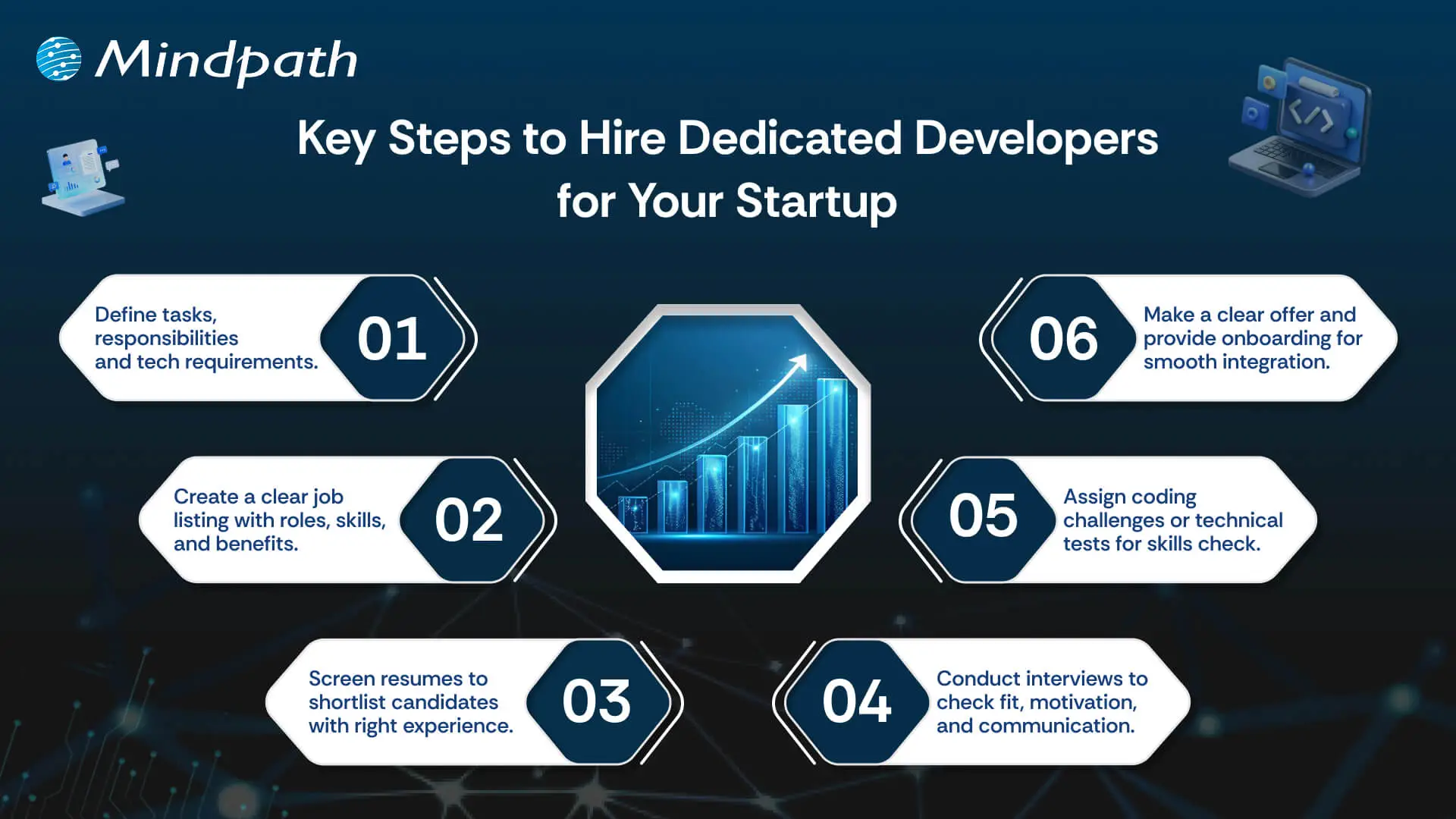
Key Steps to Hire Dedicated Developers for Your Startup

Recruiting appropriate technical talent determines the manner in which a startup is formed and developed. These are the major steps to hire dedicated developers for your startup in a clear-cut and controlled manner.

hire dedicated developer for your startup

1. Define Your Development Needs

Be clear about the tasks, responsibilities, and objectives of the developer position. Choose the technical infrastructure, level of experience, and the soft skills. Share these requirements to get the right candidates that would fit into your startup vision and culture. This will guarantee that you get the perfect match prior to the hiring process.

2. Create an Attractive Job Listing

Prepare a precise and brief job advertisement specifying the job, the requirements, and company benefits. Exhibit growth prospects and culture. Advertise in job boards, social media and professional networks to access competent candidates. A good listing attracts and enhances the quality of response.

3. Screen Resumes Efficiently

Filter through applications to identify those candidates who meet your requirements. Check technical skills, experience and applicable education. Find the transferable skills where necessary. Filter out applicants to proceed to the next step. This can save time and concentrate on the best talent.

4. Conduct Initial Interviews

Screen shortlisted candidates on the phone or via video call. Evaluate cultural fit, motivation, and communication skills. Question regarding experience and problem-solving. Present your business, objectives, and culture. This assists the two parties in assessing their compatibility prior to proceeding.

5. Test Technical Skills

Give coding challenges or relevant technical tasks. Evaluate skills based on your project needs. Ensure tests reflect real-world tasks they will handle. Review results carefully to confirm the candidate can deliver high-quality work. This step ensures practical readiness.

6. Make an Offer and Onboard

Share a clear job offer with salary, benefits, and start date. Upon acceptance, offer adequate on-boarding and support to ensure that they settle as soon as possible. Cultivate learning and development to create long-term engagement. This assists startups to successfully hire dedicated developers and assimilate them seamlessly.

Need to scale your development team quickly without long-term commitments? Explore our staff augmentation guide to learn how startups can add skilled developers on demand while staying flexible and cost-effective.

Ready to Hire Dedicated Developers in UK for Your Startup?

How well you hire the right tech candidate will help you to decide your startup’s future. If you stick to the proper procedure, you can effectively hire committed developers without wasting time. This will allow you to quickly develop and launch products, produce high-quality work, and build for long-term success. Defining what you are looking for, reviewing candidates, and assessing competencies helps minimize risks associated with the hiring process. Using this method will provide your company with a more effective development process and consequently generate superior business results.

Mindpath is your option to get the best solutions if you want to hire dedicated web developers for your startup. Our teams are committed to delivering bespoke web development services that are focused, fast, and of high quality. We are a perfect fit with your objectives as we keep on supporting and updating you. By selecting Mindpath, we guarantee your projects will be carried out efficiently, and with high technical standards.

Support Is One Click Away

Featured Posts

Related Post

Discover how containerization benefits modern development with easy management, scalability, efficiency, and security. Boost your apps today!
How much does hiring a ReactJS developer cost? Learn about factors affecting rates, and how to find the best talent within your budget.