Cloud Cost Optimization Guide for Modern Businesses 

Home

Cloud Cost Optimization Guide for Modern Businesses 

Cloud Cost Optimization Guide for Modern Businesses 

Join our Newsletter!

Cloud cost optimization

Cloud expenses continue to grow with the expansion of apps, new services, and bolt-on speedy releases. Cloud cost optimization is now the core of every intelligent IT plan. You spend on flexibility and speed, but at the end of the month, you are surprised by the costs, which often exceed your budget due to unforeseen usage spikes and the complexity of managing multiple cloud services. So, what drives this gap? More importantly, how can you gain control without hindering innovation?

Contemporary companies require performance, safety, and swiftness simultaneously. Uncontrolled resources, idle work loads and lack of visibility, however, consume budgets very fast. Hence, leaders should reconcile finance and engineering using well-defined cost objectives. Intelligent budgeting turns cloud expenditure into quantifiable value. This blog will show a practical way of gaining control of cloud investments.

Ready to take control of your cloud costs and get more from your investment? Mindpath offers cloud infrastructure services to help businesses optimize cloud usage, reduce waste, and scale efficiently.

What is Cloud Cost Optimization?

Cloud cost optimization refers to the utilization of cloud resources in a smartest manner to prevent wastage and manage costs. Companies check the usage, eliminate unnecessary services, and select appropriate pricing frameworks. This will enhance performance and minimize the unwarranted expenditure as well as keep cloud investment in line with the business objectives.

Cloud cost management helps in this endeavor to track, analyze, and plan cloud expenditure. Teams create the budgets, keep track of their usage, and reallocate the resources according to the demand. A combination of these practices aids companies in becoming financially clear, enhancing efficiency, and making superior decisions in long-term growth.

Must Read: Cloud Computing Trends 2026

Why is Cloud Cost Optimization Important?

Cloud services enable businesses to invest heavily in order to achieve growth, speed, and innovation. The reasons why cloud cost management is of critical importance in safeguarding budgets and enhancing financial control are as follows.
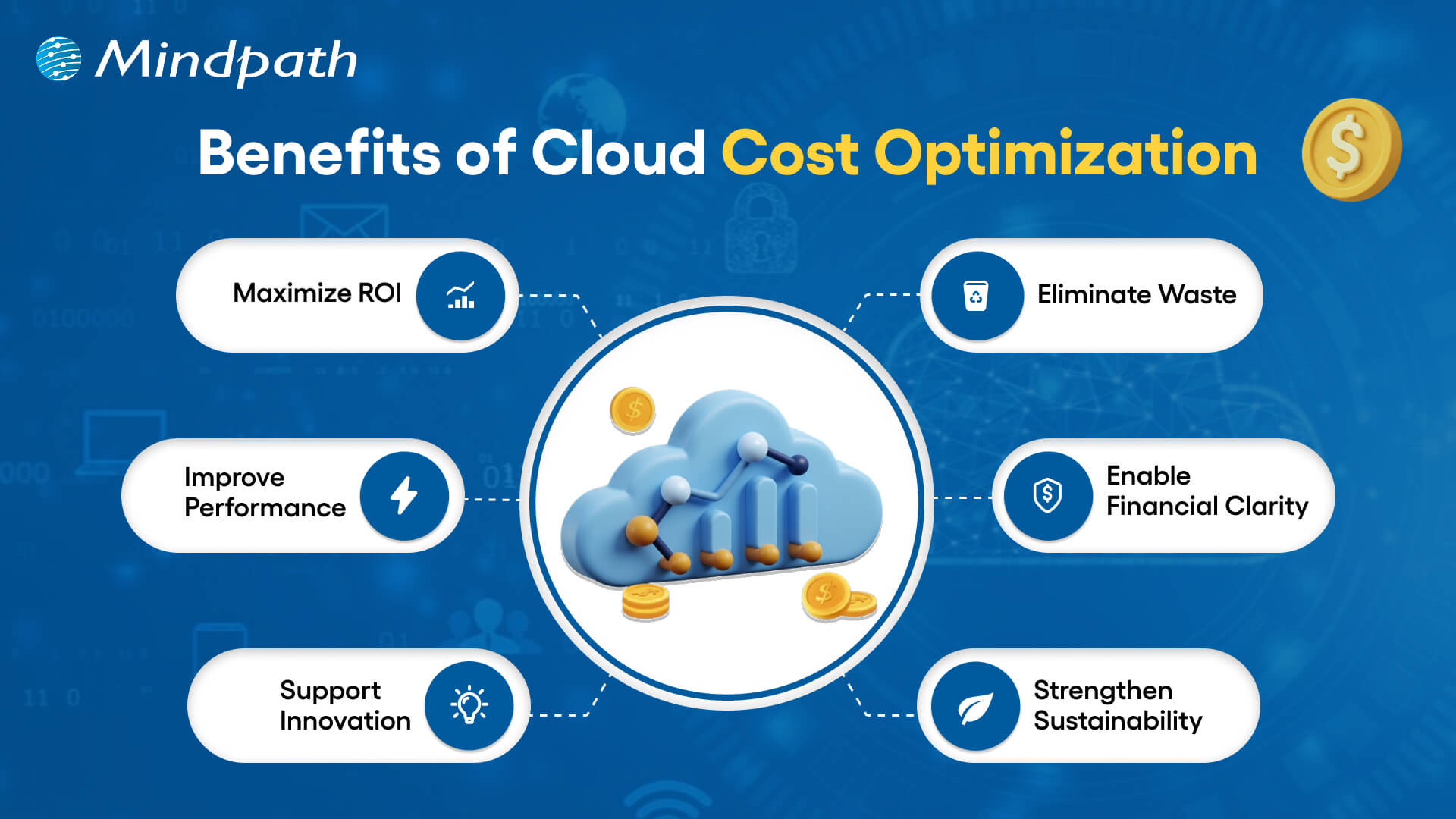
benefits of cloud cost optimization

1. Maximize ROI

Cloud expense optimization enables businesses to match expenditures with objective goals. They make sure that each dollar helps in growth, performance, and quantifiable business worth.

2. Eliminate Waste

Teams eliminate wastage of resources and storage before their expenses increase. Cloud cost optimization assists businesses in ceasing spending on services that are unnecessary.

3. Improve Performance

Organizations right-size the workloads on the basis of actual demand. This balance is also fast and reliable, as it keeps the costs down, which ultimately supports the organization’s ability to invest in new projects and innovations.

4. Enable Financial Clarity

Leaders follow usage real-time and make budgets confidentially. Being visible will avert the presence of surprise bills and enable smarter forecasting, which allows leaders to make informed financial decisions and allocate resources more effectively.

5. Support Innovation

Firms invest saved amounts in product development and online expansion. Expenditures that are managed efficiently leave opportunity for new ideas and expediency.

6. Strengthen Sustainability

Economic utilization of resources minimizes energy wastage and decreases carbon influence. Clear governance also develops team and departmental accountability.

Want to reduce cloud costs while also making your infrastructure more eco-friendly? Explore sustainable technology to build efficient and environmentally responsible systems.

Cloud Cost Optimization Strategies for Modern Businesses

Contemporary companies require effective means to regulate cloud expenses without compromising performance and scalability. Some major strategies that help companies achieve effective cloud cost optimization include the following.
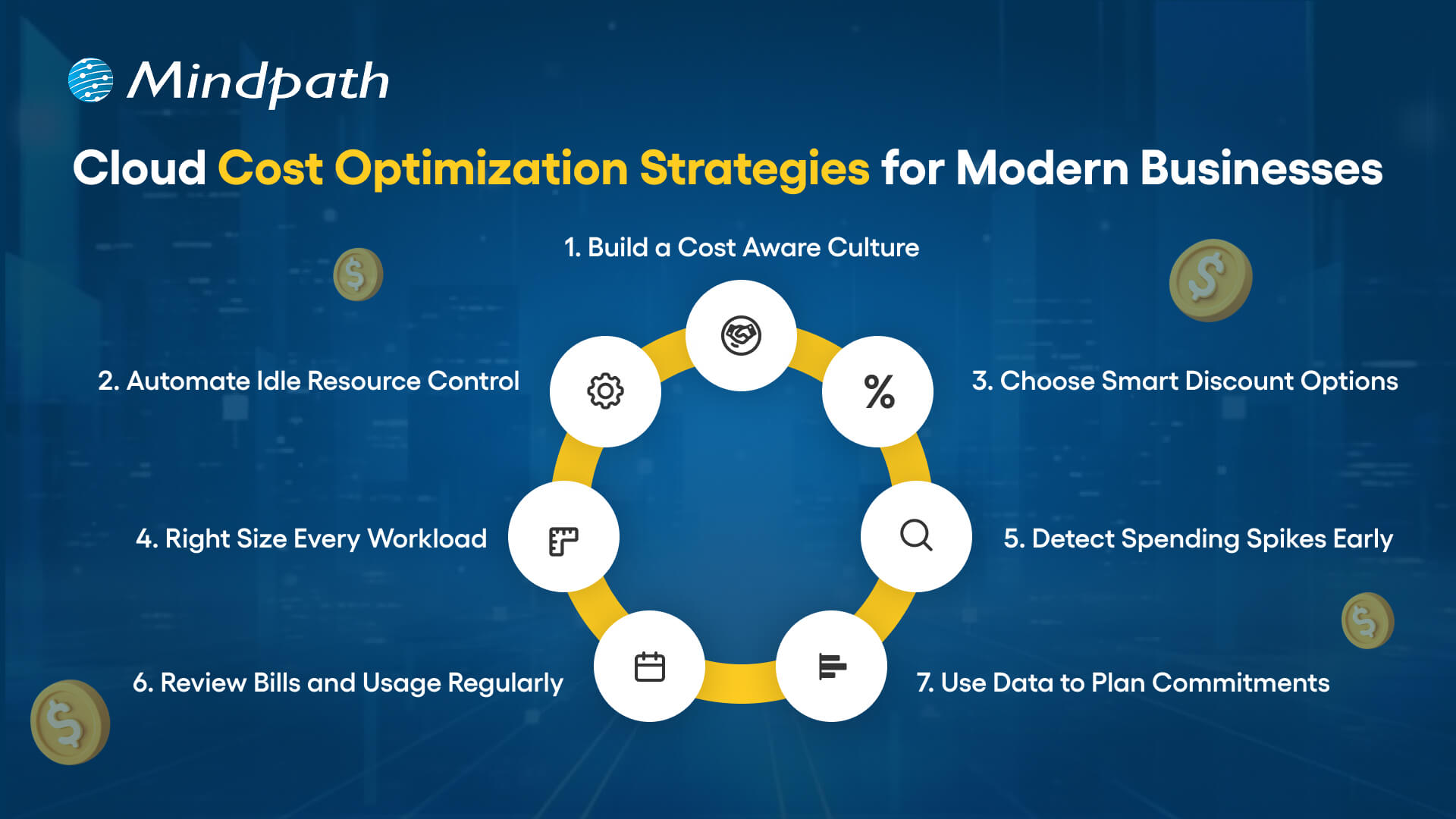
cloud cost optimization for modern businesses

1. Build a Cost Aware Culture

Clear ownership and shared responsibility are the beginning of strong cloud cost optimization. Leaders establish FinOps team and establish explicit spending policies. Teams go through regular reviews on usage and align the decisions with the business goals.

2. Automate Idle Resource Control

Unutilized servers and storage add up to high bills. Teams automate the scheduling of shutdowns and the removal of unused assets. Automation enhances the ability to optimize cost in the cloud because it avoids silent waste, which refers to the ongoing costs associated with unused resources that are not actively managed or monitored.

3. Choose Smart Discount Options

Cloud service providers also have savings plans and spot instances regarding flexibility in workloads. Workload stability is examined by teams, and then discount models are chosen. Smart commitments minimize the long-term expenses without jeopardizing performance.

Want to protect your cloud environment while optimizing costs? Explore cloud security to safeguard your systems and data effectively.

4. Right Size Every Workload

Excessively provisioned resources cost money and minimize efficiency. The teams keep tracking the CPU, memory, and storage usage. They align types of instances to actual workload requirements to facilitate cost optimization of clouds.

5. Detect Spending Spikes Early

Unplanned cost surges are hurtful to budgets and slow down planning. Real time alerts are used by teams to spot unusual usage in a short time. Timely behavior safeguards the financial control and enhances the cloud cost optimization.

6. Review Bills and Usage Regularly

The frequent examination of bills discloses outliers of costs and inefficiencies. The teams compare the present usage and the trends to identify gaps. This is followed up by constant monitoring of expenditure to ensure its congruence with approved budgets.

7. Use Data to Plan Commitments

Long-term contracts demand proper forecasting and clarity. Before commitment plans are locked teams analyze performance metrics. Data based decisions minimize risk and lead to a higher cost-efficiency.

Curious about how cloud migration supports cost optimization strategies? Check out the benefits of cloud migration to maximize your ROI.

Key Cloud Cost Optimization Tools

Businesses today need the appropriate tools to manage their expenditure and enhance visibility in the cloud setting. These are some of the important tools that can enable successful cloud cost optimization and smarter financial decisions.

1. Azure Cost Management + Billing assists teams to monitor their spending, budget and optimize Azure resources with visibility.

2. CloudZero relates cloud costs to products, features, and teams to make decisions related to the business.

3. AWS Cost Explorer and Trusted Advisor share cost-related information, usage data, and can offer recommendations applicable to make the process efficient.

4. Finout provides in-depth cost allocation analysis between various cloud and SaaS providers.

5. Google Cloud Cost Management helps to track spending and optimize usage in the GCP setups.

6. ProsperOps automates Savings Plans and Reserved Instances in order to make the maximum savings in the long term.

7. CloudHealth Victor by VMware provides business-level management, visibility and cost control in the environment.

8. Vantage provides visualized current multi cloud cost with straightforward and accurate reporting.

9. nOps applies AI based recommendations on the most economical AWS resources.

Wondering which cloud model can help you control costs and improve performance? Explore multi cloud vs. hybrid cloud to gain the clear insights.

Ready to Take Control of Your Cloud Spending?

Cloud cost optimization is beneficial to the modern business to perform cost control and enhance the performance and visibility. Businesses that audit usage, optimize resources, and automate the process of waste elimination obtain better financial control. Definite plans transform the investments in clouds into quantifiable value. By having teams focus on finance as well as engineering, teams eliminate surprise and develop long term and sustainable growth.

Mindpath is a leading provider of cloud infrastructure services, according to your business objectives. Our team is an analysis of how we use, and how we could use to waste less and be smarter with automation. We assist in the process of visibility enhancement, enhanced governance and increased returns on cloud investments. Collaborate with Mindpath to turn cloud spending into a competitive edge.

FAQs

1. What are the best practices for long term cloud cost optimization?

The following are the most appropriate practices towards long term cloud cost optimization:

  • Establish effective team ownership and accountability.
  • Set quantifiable cost targets and performance review monthly.
  • Automation is used to implement policies and avoid cost drift.
  • Use technical metrics with financial data to make smarter decisions.
  • Focus on permanent betterment to keep pace with the changing business priorities.

2. How often should businesses review their cloud cost strategy?

The teams need to observe the expenditure weekly and perform more thorough reviews every month. The regular tracking will enable the identification of trends before they turn into issues. Companies that view optimization as a continuous study make financial stability strong and give better predictions with time.

3. How can leadership teams support cloud cost management efforts?

The leadership needs to encourage transparency and foster common responsibility in spending. Effective communication between the engineering and finance enhances decision-making. Deliberate cloud cost management processes plus executive backing allow teams to remain efficiency-centered, accountable, and result-oriented.

4. What technical metrics should the team track for better cost control?

Teams need to keep track of the use of CPU resources, memory, the expansion of storage, and the pattern of data transfer. They should also monitor costs per workload and per user. These indicators assist engineers to fine-tune resources beforehand and uphold good performance without wasting resources.

5. How can Mindpath strengthen cloud cost optimization initiatives?

Mindpath provides intelligent cost control through its cloud services which offer strategic planning, automation and advanced analytics. Our professionals develop a scalable system of governance and introduce performance-driven optimization models. We assist the companies to develop sustainable cloud cost optimization that aids in growth and financial clarity.

Related Post

AI in HR

The scope of the HR role is rapidly evolving. In fact, HR is a major contributor to the success of an organization. With time, HR’s technology is evolving too, and AI or artificial intelligence is the most crucial development in this ongoing digital transformation. AI in HR is driving a seismic shift in how businesses attract, access as well and train their talent.  

It has transformed traditional hiring practices into data-driven and streamlined processes. AI for HR professionals offers a suite of advanced tools that increase efficiency, enhance candidate experience, and lower bias. 

Read on to find out how it helps improve HR function and understand how AI and HR create a powerful synergy to create teams that can lead to success. 

Want to modernize hiring and make smarter talent decisions? Mindpath’s AI development services help HR teams build intelligent, future-ready recruitment solutions.

Pre-AI Hiring Era- A System with Bias and Inefficiency

Before we delve into the actual power of AI in Human Resources, let’s first consider the challenges in the conventional hiring process.

1. Time Loss in Talent Sourcing

Talent sourcing requires time to check numerous resumes manually. It may cause lack of opportunities to talented applicants.

2. Interview Inconsistency

The evaluation process may be unfair and inconsistent in case of interviewer bias, variations in scoring and interview questions.

3. Bad Candidate Experience

Long application forms, slowness in responding, and impersonal communication may frustrate the candidates.

4. No Data-Driven Insights

Without accurate data, HR professionals generally depend on guesswork for their hiring strategies. 

5. High Employee Turnover

Using poor screening techniques can result in wrong hires. That may lead to lower productivity, increased turnover, and recruitment expenses. 

These challenges showcase the requirement for innovation. And that’s where AI in HR is offering the much-needed solutions.

Looking for ways to leverage AI to make your hiring process more efficient and future-ready? Learn how generative AI in human resources is transforming hiring practices for the future

The Emergence of Artificial Intelligence in HR

According to a report, over 51 percent of organizations are using AI in HR in 2025 (Source: SHRM). 

 It provides the evident use of AI tools to streamline recruitment processes. AI tools have become a necessity regardless of whether it involves predicting candidate success or automating HR processes.

Some of the key drivers of AI Adoption in the area of human resources are:

1. Data-driven decisions

Predictive analytics assist HR professionals to analyze if the candidate is the right fit based on a variety of factors.

2. Efficiency gains

AI tools are used to automate repetitive activities e.g. resume analysis or scheduling interviews.

3. Scalability

This enables the department to handle large numbers of applications with ease.

4. Bias Reduction

AI algorithms can be trained to reduce bias in candidate screening and selection. 

As long as it is used well, AI can be used to develop a more inclusive and agile workplace. The following sections will discuss how AI can impact the Human Resources positively.

Must Read:  Generative AI Predictions 

Generative AI for HR: A Real Game-Changer

Generative AI in HR, powered by LLMs, is now reshaping HR practices. Different tools like Jasper, HirVue, and Paradox allow HR professionals to easily create job descriptions and interview questions. It can be said that these tools offer more than just sophisticated interaction and content creation. 

1. AI-Powered Job Description Creation

Creating inclusive and compelling job descriptions can take time. Well, there are multiple generative AI tools that can make it quick and easier for HR professionals. They can: 

  • Create quality and structured job descriptions according to the requirements of the job role to attract a pool of candidates. 
  • AI can scan the possible biased language and propose an inclusive phrasing.
  • Such tools make sure that your job descriptions are optimized using the relevant keywords for search engines. 

Automation of such tasks will enable HR teams to concentrate on other important areas other than being engaged in copywriting.

2. Effortless Talent Acquisition and Recruitment

The current AI technology can be very useful in the simplification of the recruitment process. These are tools that make a great difference in candidate sourcing, assessing, and screening. The AI tools can be employed in the recruitment process in the following ways:

  • Candidate Sourcing: AI may be used to find new applicants with the required qualifications on different platforms.
  • Resume Screening: AI has the ability to quickly review numerous resumes and rank the candidates based on their experience, qualifications, skills, etc.
  • Chatbots: With the introduction of chatbots, the HR team will be able to automate the initial step of interaction, such as answering the frequently asked questions and assessing the capabilities of applicants to answer various questions.
  • Candidate Assessments: AI-assisted tools help HR get more information regarding the skills, strengths and weaknesses of the applicants in a more comprehensive and data-driven manner.

The AI tools allow HR managers to make intelligent hiring decisions and streamline the process.

Curious how advanced AI tools can give your HR processes a competitive edge? Discover the top GenAI tools that are revolutionizing AI development and could transform hiring practices.

3. Personalized Candidate Communications

AI can be used to personalize and automate communications, such as initial outreach or sending rejection letters. This will ensure that your communication is more effective. 

  • Personalized Outreach Emails: Generative AI can write emails by accessing the profile of the candidate while highlighting crucial aspects of the company culture and other relevant features.
  • Onboarding Materials: HR professionals are able to create personalized onboarding messages using AI tools. This helps new employees feel valued. 

Other than these, AI also has the potential to be used to create customized feedback for successful and unsuccessful candidates to improve candidate experience.

4. Better Employee Engagement and Experience

The success of any organization depends on a productive and content workforce. HR teams can utilize AI-based solutions to track employee engagement and improve it. Here are some of the most effective methods HR professionals can use AI tools to enhance employee experience.

  • Gathering Feedback: These tools can be used to collect feedback by sentiment analysis and survey. This will assist in gaining a breakdown of the employee engagement and morale.
  • Creating Initiatives: Artificial Intelligence assists in developing employee wellness programs that suit the abilities and requirements of the employees. Such programs are capable of supporting both the mental and physical well-being.
  • Potential Problems & Detection: HR professionals can detect the engagement patterns with the help of the predictive analytics. Consequently, they can sort out the problems before they impact productivity.

Simply put, you can use AI tools to ensure that your employees are motivated and valued at work.

5. Detailed HR Analytics & Reporting

By delivering real-time insight into workforce trends, AI-powered tools revolutionized strategic decision-making. These new tools will predict the trends in talents, measure the results of the HR investment, and track the progress of inclusion and diversity.

You can convert raw data to actionable intelligence and proactively align your team with organizational objectives using these systems.

Struggling to create engaging content that effectively supports your HR initiatives? Discover generative AI tools for content creation that can boost productivity and spark creativity in your workflow.

Tips to Introduce AI into HR

Although the opportunities of AI in HR are enormous, to reap the full benefits of the same, you must be able to make the implementation a success. The following are some tips that you can consider to achieve success and develop faster, more inclusive, and smarter workflows.

1. Know your Opportunities in Automation

Start with the routine jobs like screening of applications, interviews, correspondence etc.

2. Use Scalable AI Tools

Select Human Resource AI tools that are in line with the necessary data privacy regulations, like GDPR. Make sure that the tool facilitates transparent decision-making. 

3. Focus on Human-Centric Approaches

AI tools should assist HR teams, and not replace them. So, make sure that you maintain a good balance between these two elements. 

Exploring ways AI can enhance your hiring processes beyond traditional methods? Explore the key trends in our Generative AI Trends blog to see what’s next in HR technology.

4. Department Collaboration

Involve legal, IT, and your DIE (Diversity, Equity, and Inclusion) teams to ensure ethical and responsible deployment of AI. 

5. Begin With Pilot Projects

Test Artificial Intelligence systems in certain HR activities and keep a close eye on KPIs such as candidate satisfaction, performance, time to hire, and so on. 

6. Train HR Teams

Provide training required for your HR personnel to interpret insights and apply them with human judgment. In addition, keep the team aware of the current trends regarding AI in HR and new technologies.

AI-Powered HR – Future Trends

The future of AI in HR is bright and dynamic. We can witness further incorporation with other platforms, AI-supported DEI analytics, and voice-based screening. The HR department will acquire advanced tools to customise candidate journeys. 

Some emerging trends to consider are: 

1. Use of NLP

Natural Language Processing will enhance communication with AI systems. 

2. AI-Dirven DEI Analysis

Efficiently tracking diversity goals through real-time dashboards. 

3. Blockchain Technology

Creating more transparent and secure HR processes.

4. Voice AI Interviews

Analyzing candidate fit through assessing sentiment, communication skills, and tone. 

5. AR and VR

Enhancing candidate onboarding and training processes using Augmented Reality and Virtual Reality.

6. AI Coaching

Supporting and motivating employees’ performance and growth. 

7. Ethical AI Tools

Focusing on explainable and unbiased AI models for HR. 

Wondering how generative AI is changing not just hiring, but entire business processes? Discover how the generative AI revolution is transforming industries.

Create A Smarter HR Future With AI

As AI is reshaping the HR landscape, its integration has become a crucial aspect for every business. After all, it helps businesses to create more efficient, inclusive, and strategic hiring processes. HR professionals should adapt and leverage free AI tools for HR to stay ahead. 

If you are ready to take the right step and bring the power of AI to your HR practices, you can trust Mindpath. We can offer tailored AI development services that can help you optimize the hiring process. Furthermore, our generative AI solutions can help you generate job descriptions and automate onboarding. Partner with us and establish a precise, agile, and ethical foundation required to future-proof your hiring strategy. 

Cloud computing vulnerabilities

In the contemporary business setting, more business entities are making use of cloud services like never before. The rising popularity of cloud computing technology can be attributed to diverse factors such as high cost-effectiveness and flexibility. These cloud computing trends have contributed to the rapid adoption of cloud services. However, the increasing reliance on the cloud has escalated the risks relating to cloud computing vulnerabilities.

Businesses that plan to move to the cloud or that have already moved to the cloud need to be aware of cloud computing vulnerabilities. In addition to this knowledge, they need to be aware of ways of fixing such vulnerabilities. Such holistic knowledge can truly empower modern businesses to leverage cloud services in an optimal manner. 

Looking for a proven way to fix cloud vulnerabilities and strengthen security? Mindpath’s managed cloud services deliver expert support and 24/7 protection so you can focus on scaling.

What are Cloud Computing Vulnerabilities?

Cloud computing vulnerabilities refer to security weaknesses or gaps in the cloud computing environment. They may be exploited by hackers or cybercriminals in order to gain unauthorized access or steal confidential business information. They may also decide to exploit such vulnerabilities for the purpose of interrupting the normal services of business entities. 

Businesses need to bear in mind that such vulnerabilities may exist anywhere in the cloud environment. For instance, they may exist in the infrastructure, communication pathways, or data storage. Such vulnerabilities may be because of bugs in the software or the absence of proper encryption. It is of critical importance for businesses to locate the reasons for such vulnerabilities and address them in a prompt manner.  

Planning to secure your cloud systems against potential weaknesses? Check out cloud security tools to learn how to detect and fix vulnerabilities before they’re exploited.

Types of Cloud Computing Vulnerabilities

In the year 2026, there are a number of common cloud vulnerabilities that businesses need to be familiar with. The insight is crucial so that they can understand the serious cloud computing threats that they face in the cloud setting. Moreover, the knowledge in these areas can help them to find the right solutions to these problems. Some of the top cloud security vulnerabilities that impact businesses today include:

1. Cloud Security Misconfigurations

Cloud security misconfigurations can be defined as mistakes or errors in the setup relating to cloud systems. Such errors may give rise to vulnerabilities. Some of the common errors that may lead to vulnerabilities include the use of insecure default settings and leaving the storage accessible to the public. It is key to bear in mind that such mistakes may lead to serious security incidents for organizations.  Some of the common consequences include unauthorized access, data breach incidents, and many other incidents. 

2. Insecure API

In cloud computing, insecure APIs can be defined as flaws or weaknesses in the application. These types of cloud security vulnerabilities may be because of the adoption of poor coding practices or the absence of proper API authentication protocols. Some of the common kinds of API vulnerabilities include injection flaws, high data exposure, and broken authentication. The insecure nature of APIs makes them vulnerable to different types of cyberattacks, such as injection attacks, as well as denial-of-service attacks. 

3. Absence of Visibility

In the cloud computing context, the issue relating to the absence of visibility arises when organizations struggle to monitor as well as track activities within their cloud environment. Due to this issue, they may not be aware of which users are accessing data or which particular data is being accessed in the cloud environment. In the absence of proper visibility, organizations are likely to face difficulty in effectively detecting cloud computing security threats. It is a serious vulnerability that business entities cannot ignore since it can increase the possibility of attacks on the cloud.

4. Poor Authentication and Authorization Protocols

In case cloud systems fail to effectively verify the identity of users and manage their access controls, it may lead to unauthorized users gaining access to the environment. It may compromise the quality of sensitive data. Some of the common authentication vulnerabilities include the use of weak passwords and the absence of multi-factor authentication. Furthermore, in case users are granted more access than necessary, it may lead to data leaks or abuse of power. It is key for organizations to make sure that only authorized users are able to access specific resources and data. 

5. Insider Threats

Insider threats refer to the cloud computing attacks that arise from individuals who exist within the organization. They could be employees, business partners, or even former employees. Insider threats basically have legitimate access to the cloud environment, and they take advantage of this power and are responsible for attacks on the cloud. They may misuse their power to steal confidential information or leak sensitive data to outsiders.

A broad range of vulnerabilities may exist in the cloud setting. Organizations need to adopt a proactive approach to tackle such issues in a prompt and proactive manner. It is essential to fix the vulnerabilities as soon as they are found, and also to promote cybersecurity resilience within the organization.  

Planning to simplify application deployment in the cloud? Explore serverless architecture in cloud computing to learn how you can build apps without managing servers.

Best Practices to Fix Cloud Computing Vulnerabilities

Now that you are aware of some of the most common cloud computing threats, you need to expand your insight into how to manage such vulnerabilities. Business entities need to adopt best practices and deploy proper measures in place so that they can capitalize on the cloud computing technology in an optimal manner. Some of the best practices that can help fix cloud computing vulnerabilities include:

1. Keeping Up with Patch Management

Business entities that use cloud services need to keep up with patch management. It is crucial for businesses to methodically identify, test, and deploy the necessary software updates. Moreover, they need to prioritize proper security configuration so that gaps can be eliminated that may be exploited by cybercriminals and other malicious actors. 

2. Using Identity and Access Management Solutions

It is a must for modern businesses to use Identity and Access Management (IAM) solutions. It can help restrict unauthorized access to the cloud resources and infrastructure of the business. You need to make sure that appropriate policies, practices, and protocols are in place that make sure that the right individuals can have the right access to the right kind of resources. 

3. Regular Back-Up of Data

Businesses face a high level of uncertainty in the prevailing business landscape. In such times, it is essential to maintain frequent back-ups of data. Additionally, the principle relating to least privilege access must be followed at all times. It is key to establish a zero-trust cloud security architecture while hardening the network security.  These cloud security solutions are a must to tackle the vulnerabilities that arise in the cloud environment. 

4. Strengthening Of Data Governance Policies

Business entities that intend to strengthen their cloud vulnerability management must make sure that robust data governance policies and standards are in place. It is equally important to consolidate cloud security solutions so that the issue relating to silos can be eliminated. Business owners need to prioritize an incident response plan as well. It can guide the authorized personnel to adopt appropriate measures while handling a challenging situation.

5. Enabling Multi-Factor Authentication

Multi-factor authentication is the security process that requires two or more verification methods for the purpose of logging in. It makes it harder for unauthorized users to gain access to an account. In order to minimize cloud vulnerabilities and mitigate cloud security risks, organizations need to adopt the practice of multi-factor authentication. It can minimize the risk of unauthorized parties gaining access to your cloud infrastructure. Multi-factor authentication is equally important to check API configurations as well as address any security misconfiguration issues that may exist. 

It is crucial for businesses to bear in mind that cloud vulnerability management is an ongoing process. Business entities need to be alert and vigilant at all times so that they can locate any kind of security weaknesses or gaps that may exist in the environment. Businesses must also train their staff so that they can identify gaps in the security posture and inform the appropriate personnel immediately. 

Ready to modernize your cloud infrastructure? Explore multi-cloud vs. hybrid cloud to see which strategy aligns with your goals.

Final Words

Organizations may not be able to predict cloud computing vulnerabilities as they are diverse in nature. However, malicious actors may exploit them and cause serious damage to the organizations that operate today. It is essential for business entities to be aware of the major cloud vulnerabilities. In order to maintain a secure posture, it is important to adopt best practices relating to cloud vulnerability management. 

Mindpath’s top-quality cloud-managed services can certainly ensure that no vulnerabilities arise in your path while leveraging our cloud services. Our experts will ensure that you can get professional help to effectively overcome possible complexities and challenges in your journey. 

Support Is One Click Away

Featured Posts

Related Post

Discover the ultimate guide to hiring Node.js developers in London. Learn about the skills, benefits, and cost factors involved in finding the right talent for your project.