Cloud Cost Optimization Guide for Modern Businesses 

Home

Cloud Cost Optimization Guide for Modern Businesses 

Cloud Cost Optimization Guide for Modern Businesses 

Join our Newsletter!

Cloud cost optimization

Cloud expenses continue to grow with the expansion of apps, new services, and bolt-on speedy releases. Cloud cost optimization is now the core of every intelligent IT plan. You spend on flexibility and speed, but at the end of the month, you are surprised by the costs, which often exceed your budget due to unforeseen usage spikes and the complexity of managing multiple cloud services. So, what drives this gap? More importantly, how can you gain control without hindering innovation?

Contemporary companies require performance, safety, and swiftness simultaneously. Uncontrolled resources, idle work loads and lack of visibility, however, consume budgets very fast. Hence, leaders should reconcile finance and engineering using well-defined cost objectives. Intelligent budgeting turns cloud expenditure into quantifiable value. This blog will show a practical way of gaining control of cloud investments.

Ready to take control of your cloud costs and get more from your investment? Mindpath offers cloud infrastructure services to help businesses optimize cloud usage, reduce waste, and scale efficiently.

What is Cloud Cost Optimization?

Cloud cost optimization refers to the utilization of cloud resources in a smartest manner to prevent wastage and manage costs. Companies check the usage, eliminate unnecessary services, and select appropriate pricing frameworks. This will enhance performance and minimize the unwarranted expenditure as well as keep cloud investment in line with the business objectives.

Cloud cost management helps in this endeavor to track, analyze, and plan cloud expenditure. Teams create the budgets, keep track of their usage, and reallocate the resources according to the demand. A combination of these practices aids companies in becoming financially clear, enhancing efficiency, and making superior decisions in long-term growth.

Must Read: Cloud Computing Trends 2026

Why is Cloud Cost Optimization Important?

Cloud services enable businesses to invest heavily in order to achieve growth, speed, and innovation. The reasons why cloud cost management is of critical importance in safeguarding budgets and enhancing financial control are as follows.
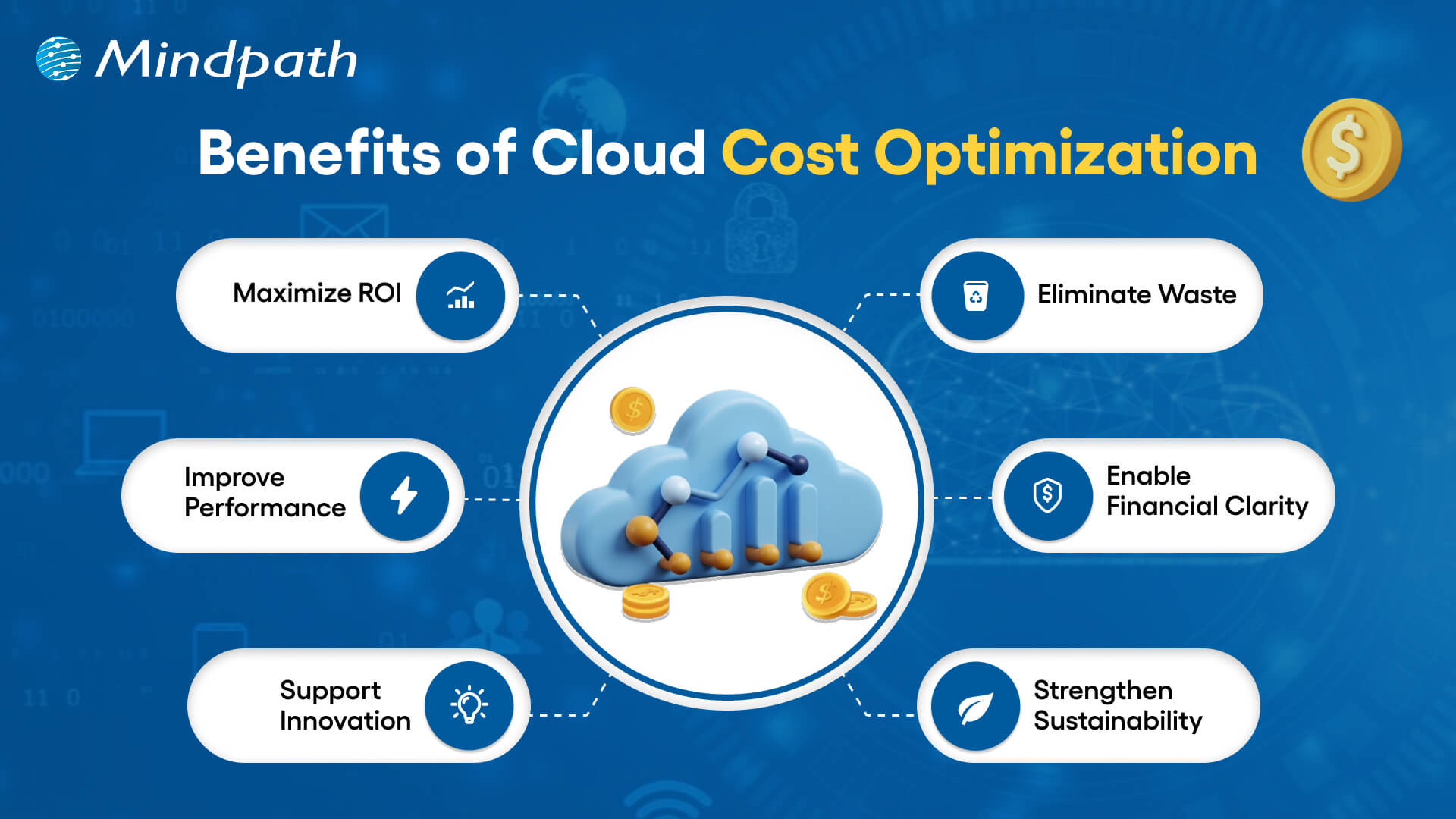
benefits of cloud cost optimization

1. Maximize ROI

Cloud expense optimization enables businesses to match expenditures with objective goals. They make sure that each dollar helps in growth, performance, and quantifiable business worth.

2. Eliminate Waste

Teams eliminate wastage of resources and storage before their expenses increase. Cloud cost optimization assists businesses in ceasing spending on services that are unnecessary.

3. Improve Performance

Organizations right-size the workloads on the basis of actual demand. This balance is also fast and reliable, as it keeps the costs down, which ultimately supports the organization’s ability to invest in new projects and innovations.

4. Enable Financial Clarity

Leaders follow usage real-time and make budgets confidentially. Being visible will avert the presence of surprise bills and enable smarter forecasting, which allows leaders to make informed financial decisions and allocate resources more effectively.

5. Support Innovation

Firms invest saved amounts in product development and online expansion. Expenditures that are managed efficiently leave opportunity for new ideas and expediency.

6. Strengthen Sustainability

Economic utilization of resources minimizes energy wastage and decreases carbon influence. Clear governance also develops team and departmental accountability.

Want to reduce cloud costs while also making your infrastructure more eco-friendly? Explore sustainable technology to build efficient and environmentally responsible systems.

Cloud Cost Optimization Strategies for Modern Businesses

Contemporary companies require effective means to regulate cloud expenses without compromising performance and scalability. Some major strategies that help companies achieve effective cloud cost optimization include the following.
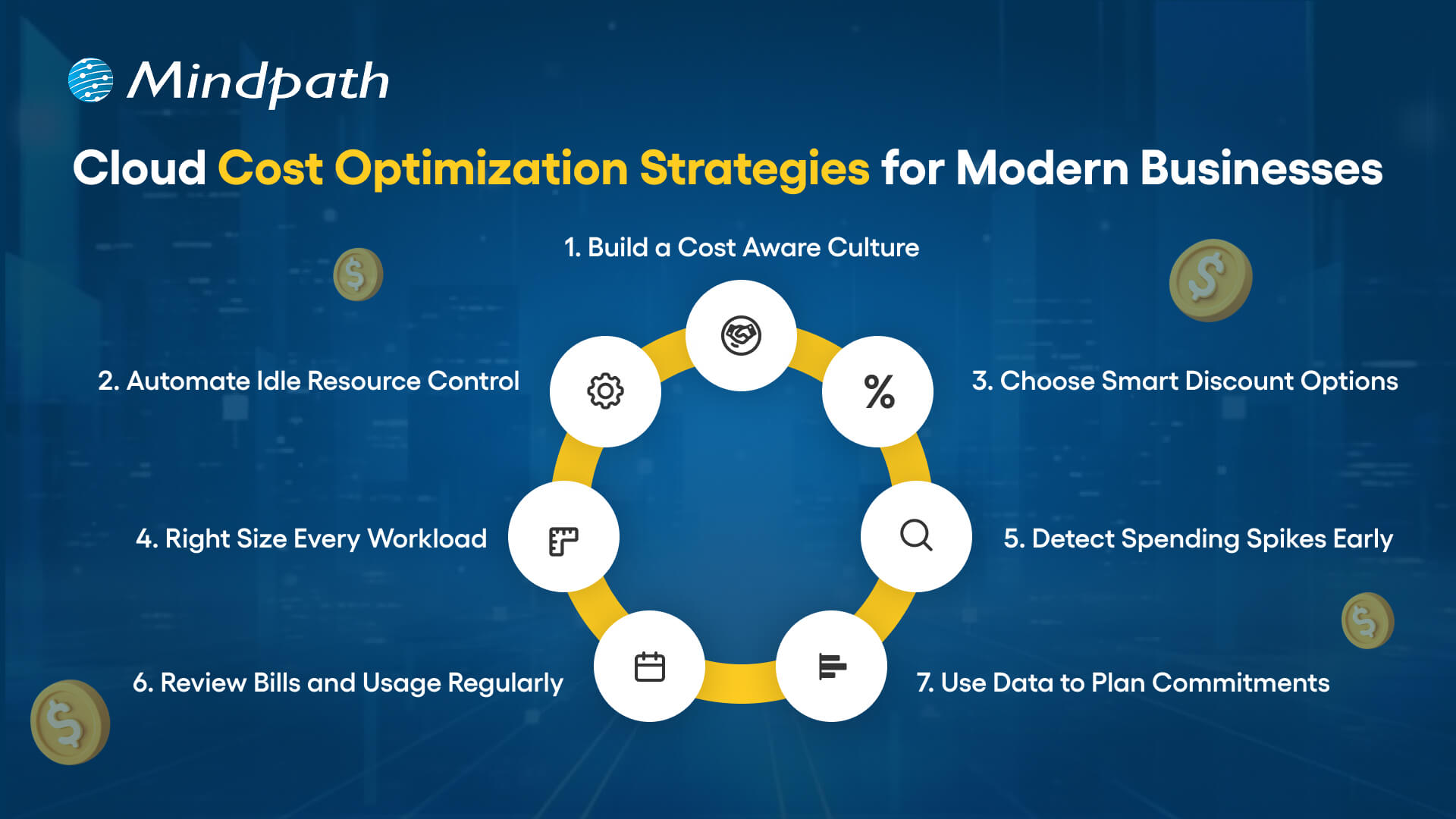
cloud cost optimization for modern businesses

1. Build a Cost Aware Culture

Clear ownership and shared responsibility are the beginning of strong cloud cost optimization. Leaders establish FinOps team and establish explicit spending policies. Teams go through regular reviews on usage and align the decisions with the business goals.

2. Automate Idle Resource Control

Unutilized servers and storage add up to high bills. Teams automate the scheduling of shutdowns and the removal of unused assets. Automation enhances the ability to optimize cost in the cloud because it avoids silent waste, which refers to the ongoing costs associated with unused resources that are not actively managed or monitored.

3. Choose Smart Discount Options

Cloud service providers also have savings plans and spot instances regarding flexibility in workloads. Workload stability is examined by teams, and then discount models are chosen. Smart commitments minimize the long-term expenses without jeopardizing performance.

Want to protect your cloud environment while optimizing costs? Explore cloud security to safeguard your systems and data effectively.

4. Right Size Every Workload

Excessively provisioned resources cost money and minimize efficiency. The teams keep tracking the CPU, memory, and storage usage. They align types of instances to actual workload requirements to facilitate cost optimization of clouds.

5. Detect Spending Spikes Early

Unplanned cost surges are hurtful to budgets and slow down planning. Real time alerts are used by teams to spot unusual usage in a short time. Timely behavior safeguards the financial control and enhances the cloud cost optimization.

6. Review Bills and Usage Regularly

The frequent examination of bills discloses outliers of costs and inefficiencies. The teams compare the present usage and the trends to identify gaps. This is followed up by constant monitoring of expenditure to ensure its congruence with approved budgets.

7. Use Data to Plan Commitments

Long-term contracts demand proper forecasting and clarity. Before commitment plans are locked teams analyze performance metrics. Data based decisions minimize risk and lead to a higher cost-efficiency.

Curious about how cloud migration supports cost optimization strategies? Check out the benefits of cloud migration to maximize your ROI.

Key Cloud Cost Optimization Tools

Businesses today need the appropriate tools to manage their expenditure and enhance visibility in the cloud setting. These are some of the important tools that can enable successful cloud cost optimization and smarter financial decisions.

1. Azure Cost Management + Billing assists teams to monitor their spending, budget and optimize Azure resources with visibility.

2. CloudZero relates cloud costs to products, features, and teams to make decisions related to the business.

3. AWS Cost Explorer and Trusted Advisor share cost-related information, usage data, and can offer recommendations applicable to make the process efficient.

4. Finout provides in-depth cost allocation analysis between various cloud and SaaS providers.

5. Google Cloud Cost Management helps to track spending and optimize usage in the GCP setups.

6. ProsperOps automates Savings Plans and Reserved Instances in order to make the maximum savings in the long term.

7. CloudHealth Victor by VMware provides business-level management, visibility and cost control in the environment.

8. Vantage provides visualized current multi cloud cost with straightforward and accurate reporting.

9. nOps applies AI based recommendations on the most economical AWS resources.

Wondering which cloud model can help you control costs and improve performance? Explore multi cloud vs. hybrid cloud to gain the clear insights.

Ready to Take Control of Your Cloud Spending?

Cloud cost optimization is beneficial to the modern business to perform cost control and enhance the performance and visibility. Businesses that audit usage, optimize resources, and automate the process of waste elimination obtain better financial control. Definite plans transform the investments in clouds into quantifiable value. By having teams focus on finance as well as engineering, teams eliminate surprise and develop long term and sustainable growth.

Mindpath is a leading provider of cloud infrastructure services, according to your business objectives. Our team is an analysis of how we use, and how we could use to waste less and be smarter with automation. We assist in the process of visibility enhancement, enhanced governance and increased returns on cloud investments. Collaborate with Mindpath to turn cloud spending into a competitive edge.

FAQs

1. What are the best practices for long term cloud cost optimization?

The following are the most appropriate practices towards long term cloud cost optimization:

  • Establish effective team ownership and accountability.
  • Set quantifiable cost targets and performance review monthly.
  • Automation is used to implement policies and avoid cost drift.
  • Use technical metrics with financial data to make smarter decisions.
  • Focus on permanent betterment to keep pace with the changing business priorities.

2. How often should businesses review their cloud cost strategy?

The teams need to observe the expenditure weekly and perform more thorough reviews every month. The regular tracking will enable the identification of trends before they turn into issues. Companies that view optimization as a continuous study make financial stability strong and give better predictions with time.

3. How can leadership teams support cloud cost management efforts?

The leadership needs to encourage transparency and foster common responsibility in spending. Effective communication between the engineering and finance enhances decision-making. Deliberate cloud cost management processes plus executive backing allow teams to remain efficiency-centered, accountable, and result-oriented.

4. What technical metrics should the team track for better cost control?

Teams need to keep track of the use of CPU resources, memory, the expansion of storage, and the pattern of data transfer. They should also monitor costs per workload and per user. These indicators assist engineers to fine-tune resources beforehand and uphold good performance without wasting resources.

5. How can Mindpath strengthen cloud cost optimization initiatives?

Mindpath provides intelligent cost control through its cloud services which offer strategic planning, automation and advanced analytics. Our professionals develop a scalable system of governance and introduce performance-driven optimization models. We assist the companies to develop sustainable cloud cost optimization that aids in growth and financial clarity.

Related Post

staff augmentation hiring

Staff augmentation has turned out to be a popular strategy for businesses that want to access specialised skills. As per the recent statistics, the IT staff augmentation market size is going to reach USD 857.2 billion by 2032 (Source). This approach can help you scale your workforce while remaining ahead in the competitive landscape.

If you are also thinking of staff augmentation hiring, there are several key factors that should be carefully considered. This ensures a seamless and effective integration of external experts into your organisation. In this blog, we will further explore what you should take into account when your staffing solution demands quality staff augmentation.

Looking for a faster way to strengthen your workforce without compromising on quality? At Mindpath, we offer staff augmentation services that help you scale your team with highly qualified professionals.

What Does Staff Augmentation Hiring Actually Mean?

Staff augmentation is a practice where you temporarily add external professionals to your existing workforce. Further, 65% of recruiters are including AI tools in staff augmentation to support talent acquisition (Source). These experts bring specialised skills and new perspectives. They also have the ability to get along with your team effectively while understanding your team’s dynamics.

So, whether you demand a professional developer or a financial analyst, hire talent through staff augmentation if you want a solution without any permanent hiring commitment.

Must Read: Staff Augmentation Trends

Staff Augmentation Best Practices that Let Your Company Perform Exceptionally

It is necessary for your business to meet the changing technology requirements of the digital world. Further, you need to keep your resources intact while keeping the project on track. The staff augmentation model accesses organisations to effectively fill in the skills gaps and maintains flexibility that is not possible in traditional hiring.

However, successful staff augmentation hiring needs careful planning and the right approaches, as given in this section.

1. Be Clear About Your Needs

Before you initiate the process of hiring through staff augmentation, it is important to have clarity about your business’s specific requirements. Understand what skills or expertise you are lacking internally? What are your goals, and why do you intend to outsource a new team?

Accurately defining your requirements can help you find the right talent. One of the most essential staff augmentation best practices is having clarity. The more precise your expectations are, the better the results will be.

2. Pick the Right Staff Augmentation Model

Not every project needs the same level of external support. There are some common types of staff augmentation models that are listed here.

  • Long-Term Augmentation

 This is effective for your ongoing projects that need to be completed within a given timeframe.

  • Short-Term Augmentation

 This approach is suitable for urgent or temporary requirements.

  • Skill-Based Augmentation

It is necessary when you require specific skills for your project.

3. Partner with a Reputable and Experienced Provider

Selecting the right IT staff augmentation services is a critical step in the whole process. So, you must research and pick a reputable company with a good track record of success. Further, the provider should have a well-established talent pool and a history of offering top-rated professionals. The team should also align with your business requirements.

4. Verify their Collaborative Features

Instead of just valuing the technical skills of the experts, you should also assess their collaborative standards. They should match your team’s communication approaches while showing compatibility with the workflow. You can also assess their language proficiency and ability to work in collaborative environments.

Poor or ineffective communication can delay your projects while increasing the misunderstanding rate. A good cultural fit ensures a seamless integration while developing your productivity aspects.

5. Be Assured of Data Security

When you hire talent through staff augmentation, the team might have access to your data. So, before you make a deal with them, sign NDAs and agreements. Ask about the security policies and restrict access as per the required roles. You shouldn’t ignore the security aspects at all. A single breach can tarnish your market reputation within minutes.

Planning to scale your workforce without overspending on full-time hires? Discover our cost-effective IT staff augmentation blog to learn practical cost-saving approaches while enhancing your workforce.

6. Go through the Pricing Structure

Average IT staff augmentation costs between USD 50,000 and USD 199,999. However, the pricing differs as per the requirements of your business. So, be assured of the providers’ monthly and hourly costs.  Also assess their administrative fees or if they have any hidden costs. Ask about their overtime policies and replacement guarantees.

7. Verify their Flexibility

Your project requirements might change anytime. A reliable staff augmentation model should allow you to scale your resources as needed. It should also allow you to replace underperforming talent quickly and add new skill sets when required.

Flexibility ensures your team can adapt to any changes without any delays.

8. valuate their Performance

Establish clear performance metrics and KPIs to verify the effectiveness of your augmented staff. Verifying the team on a daily basis can make the external team understand your project values while helping your project get completed on time.

9. Plan a Seamless Onboarding Process

Even experienced professionals seek clarity when it comes to keeping their project aligned with the business. So, your structured staff augmentation hiring process should remain clear about your needs. The external team should have precise access to tools and documentation. You should introduce them to your internal teams and define the workflows.

10. Exit Strategy

Understand what you are going to do when the specific project is completed. Make a plan for your transition and assess when you should end the services of your outsourced team.

Looking to streamline your team integration process for faster results? Check out our augmented staff onboarding guide to learn proven strategies for seamless execution.

Why Staff Augmentation Hiring is a Strategic Approach for Your Company?

The staff augmentation model can offer you a series of benefits if you implement it correctly.

  • It can help you hire faster as compared to traditional recruitment processes.
  • It offers access to global talent pools.
  • You can enjoy greater project flexibility and reduced operational charges.
  • Further, your project delivery will be completed within the given timeline.

Common Mistakes to Avoid in Staff Augmentation Hiring

While the model is very effective, organisations still make such mistakes that need to be avoided.

  • Selecting vendors based only on cost.
  • Hiring with clear project objectives.
  • Ignoring cultural fit.
  • Lack of onboarding and performance assessment.

Avoiding or preventing such mistakes can help your staff augmentation hiring be more result-oriented and convenient as per the market needs.

Looking to choose the right outsourcing model for your business needs? Check out our staff augmentation vs managed services comparison to learn the key differences and benefits.

When You Should Hire Talent through Staff Augmentation?

Consider this valuable approach if you need to quickly scale your development team or you want to bridge the skill gap. An outsourced team can easily support a new product launch while helping you with digital transformation. Most importantly, it can reduce the hiring overhead. IT augmentation services offer flexibility, speed, and long-term employment commitments that encourage your business productivity.

Bottom Line

Hiring talent through staff augmentation can be a strategic approach that can help your organisation with the right skills and expertise. Moreover, it can help you stand strongly in today’s competitive business environment. By following the staff augmentation best practices, you can easily build high-performing teams quickly.

If your company is looking forward to hiring talent through staff augmentation, benefit from working with professional providers who understand your project dynamics. They also understand your technical requirements and team integration. With Mindpath, staff augmentation services, your business can easily access knowledgeable industry experts. Further, we can assure you of achieving all your technology goals without any risks and delays.

Explore key factors for hiring talent through staff augmentation, compare with other methods, and discover Mindpath’s services for scaling and modernizing your tech.
Digital Twin technology

Manufacturers all over the world have been under pressure to meet emerging challenges in an environment with limited resources. The prominent setbacks for the manufacturing industry include supply chain shortages and talent gaps. However, the advent of digital twin technology serves as the best example of how technological innovation can shape the future of manufacturing. Digital twins can not only enhance capacity but also ensure more efficiency and resiliency in manufacturing operations.

The growing demand for fast-paced and continuous operations in manufacturing creates various limitations. Digital twins offer virtual representations of production lines, equipment or the whole factory to help manufacturers with more effective decision-making. Manufacturers must know about the utility of digital twins and how they can unlock untapped value to prepare factories of the future.

Looking to harness digital twin technology to gain deeper insights and future-proof your business? Contact us for expert guidance and tailored solutions that help turn digital twin innovation into real-world impact.

Understanding the Digital Twin Technology

The foremost highlight in any introduction to digital twins will focus on their definition. The most common answers to ‘what is digital twin technology’ paint them as virtual representations of physical objects or systems. Digital twins use real-time data to imitate the behavior, conditions and performance of their physical counterparts. Digital twins help with continuous monitoring and analysis of objects, systems or products throughout their complete lifecycle. In addition, digital twins can also feature external processes and crucial variables that can influence the performance of real-world assets.

One of the significant highlights of digital twins is that they work with data flowing between the object and its virtual representation in real-time. The two-way flow of data ensures the most accurate simulations of the physical world. Businesses can also use multiple digital twins together to create models for more complex systems, aimed at a larger digital transformation strategy.

Digital twins provide a clear impression of how something works and predicts its behavior in future scenarios. As a result, they can help in accelerating innovation and improving efficiency along with making well informed decisions. You can come across use cases of digital twins in predictive maintenance, product development, supply chain optimization and process optimization.

Breaking Down the Architecture of Digital Twins

If you want to capitalize on the power of digital twins in diverse use cases, then it is important to know their architecture. You can find digital twin providers like IBM, Microsoft, General Electric and Siemens with solutions that provide a comprehensive suite of services. The digital twin examples may feature hardware layers, synchronization services, data processors and other tools to draw the most accurate simulations of real objects and processes. However, awareness of the architecture of digital twins can help you figure out exactly what you need to make the most of the innovative technology.

1. Physical Asset

The physical asset in digital twins can be any real-world object, process or system that you want to study or monitor within virtual environments.

2. Virtual Model

The virtual model in digital twins is the digital representation of the physical asset that you want to know more about.

3. Data Sources

One of the notable highlights in the answers to ‘what is a digital twin’ points at the two-way flow of data between the physical asset and the virtual model. Data sources are an integral component in digital twin architecture as they ensure accuracy in virtual representations. Internet of Things or IoT devices serve as data sources by recording relevant metrics for creating digital twins.

4. Data Pipelines

Data pipelines are used for transmitting sensor data to the virtual model in real time. They play a vital role in ensuring that the digital twin is synchronized with the physical asset.

5. Feedback Loop

The feedback loop helps in sending control signals or insights from the virtual model to the physical asset. It serves as a promising component for optimizing performance and efficiency alongside enhancing decision-making.

6. Analytics Engine

Digital twins needs an analytics engine running on AI or machine learning to detect patterns and facilitate predictive analytics. The functionalities of the analytics engine helps in drawing accurate simulations alongside offering support for effective asset tracking.

7. Visualization Dashboard

The visualization dashboard is another crucial component that completes the digital twin definition by providing access to the virtual representation. You can use the visualization dashboard to interact with the two-dimensional or 3D representation of the physical asset.

Breaking Down the Working Mechanism of Digital Twins

The uses of digital twins can vary by huge margins across different industries and applications. You must also know that digital twins follow some common steps that you will find in every example.

1. Data Collection

Organizations can start their digital twin projects by embedding sensors on a physical object to capture its performance, operating environment and condition. The digital twin meaning in case of IoT applications revolves around using smart objects that feature in-built sensors to collect and share data continuously. In the case of IT environments, teams can create digital representations of computers, applications and software with virtualization technologies. Subsequently, the teams can use software agents to collect data from the digital asset for supporting the digital twin.

2. Creation of the Virtual Model

The primary focus of digital twins aligns with the creation of digital replicas of certain objects or systems. Virtual modeling involves using the data collected from the physical asset to create a digital model. It is important to define digital twins with key attributes that help them offer realistic reactions to variables. The variables can refer to interactions with the physical asset or its environmental conditions. The attention to virtual modeling ensures that digital twins can offer reliable and accurate simulation of the responses of the physical assets in different conditions.

3. Real-Time Data Integration

You cannot think of a digital twin without live data integration as it ensures continuous communication between the digital twin and physical asset in real time. Live data integration offers a dynamic feedback loop that can help organizations with performance optimization and enhancements in system reliability. The two-way data exchange also helps in efficient predictive maintenance by anticipating issues ahead of time. Most of the organizations automate the real-time data exchange process to focus on more critical and strategic tasks.

4. Analysis and Decision-Making

Digital twins offer the most promising solutions to experiment safely within virtual environments. You find better answers to ‘how do digital twins work’ in manufacturing plants where digital twins can help in finding out how an upgrade may affect efficiency and performance. The best thing here is that manufacturers don’t have to implement the upgrade directly to measure its impact. On top of it, analytics engines used in digital twins can recommend operational changes to make the changes more cost-effective.

Variants of Digital Twins

Most of the discussions about digital twins don’t emphasize the fact that you can find different types of digital twins. Organizations can deploy different variants of digital twins in one production environment with the advantage of learning from different levels of physical assets.

1. Product Twins

Product twins refer to the virtual representations of products after the ideation stage or throughout the complete lifecycle. You can use product digital twins for design improvements, enhancing service satisfaction and manufacturing efficiency.

2. Process Twins

The variety of digital twin applications also draws attention towards the use of process twins that help in understanding how different systems work with each other. Process twins offer visualization of the interactions between systems and suggest actionable feedback to improve quality standard or process speed.

3. Part Twins

Part twins or component twins focus on the most granular level of larger systems. The primary goal of part twins revolves around measuring the insights from basic components of larger systems. Component twins serve a promising role in understanding the performance of certain components and identifying larger problems before they happen.

4. Place Twins

The largest deployment of digital twins can happen in the form of place twins. You can find examples of place twins in factory twins, which simulate a complete physical location or place. In some cases, you may assume similarities between process twins and place twins. However, place twins also include spatial data, such as climate, context and temperature of the physical location.

Unraveling the Use Cases of Digital Twins

Organizations in different industries leverage digital models to understand complex systems and promote innovation. Digital models have also proved as the most useful tools for efficient optimization and predictive equipment maintenance. You can find a digital twin use case in almost every major industry with widespread applications.

1. Construction of Physical Structures

Digital twins can prove to be the most useful tools for engineers to design durable and safe physical structures, such as buildings, bridges and dams. For example, digital twins can help engineers determine whether a specific design for a bridge can enhance its durability. As a result, engineers can identify any setbacks and make changes in the design before starting construction.

2. Healthcare

Another promising area where digital twins can offer significant advantages is in the domain of healthcare. Digital twins can come up with crucial insights from forecasts of disease progression to identify how patients will respond to different treatment options. Furthermore, healthcare professionals can use digital twins to enhance diagnosis through detailed modeling that helps in understanding how interactions between organs can affect health.

3. Urban Planning

You can also notice the benefits of digital twins in urban planning applications, especially for traffic supervision. City models use spatial data, IoT object data and AI analytics to determine how new transportation systems or infrastructure upgrades will affect the city’s environment and traffic. Digital twins serve a pivotal role in planning for smart cities and urban planning experts aim to tap into their power to enhance sustainability and quality of life.

Identifying the Advantages of Digital Twin Technology

The use cases of digital twins across different industries reveal their potential to revolutionize digital transformation. You can notice how digital twins offer more visibility into complex systems while opening doors for experimentation without real-world changes. An overview of their advantages can help you understand how they can unlock the future.

1. Faster Research and Development

How do you think a business can step into the future ahead of time? Without research and development, companies cannot experiment with new product designs, manufacturing processes or workflows. The advantages of digital twins make it easier to experiment within a virtual environment, thereby opening the doors for accelerated innovation. Digital twins offer a more cost-effective and safer approach to research and development without the need for real tests.

2. Scalability

Companies can stay competitive in the modern business landscape only by adapting to changes in product demand, customer priorities and economic conditions. Digital twins offer virtual environments where you can adjust parameters and test configurations safely before full-scale deployment. You can also connect digital twins to live systems and ensure that they can continuously transmit their scaling adjustments in real time to the physical asset.

3. Operational Efficiency

The next crucial outcome of digital twin technology is the assurance of enhanced operational efficiency. Digital twins can provide the insights required to achieve operational efficiencies throughout the value chain. Organizations can use different datasets to collect real-time data on physical asset and production performance. With more visibility into the asset or process bottlenecks, digital twins can help in crafting potential solutions.

Final Thoughts

The progressive use of digital twins is a perfect example of how the world is welcoming innovation and preparing for the future. Digital twins provide the easiest solution to multiple problems that affect efficiency, cost-effectiveness and productivity in different industries. With the help of virtual models that mimic real-world assets, companies can reinvent their manufacturing, services and internal management.

Mindpath is one of the leading destinations for digital twin app development with years of expertise in end-to-end IT solution development. We are proud to have team members who are eager to learn and specialize in new technologies, including digital twins. Our experts are familiar with the use of popular tech stacks for digital twin development in alignment with your business goals. Consult with our team and build your first digital twin right now.

Discover how digital twin technology boosts efficiency, enhances product quality, and supports sustainability. Learn its impact on modern businesses and industry sectors.

Support Is One Click Away

Featured Posts

Related Post