Custom AI Development: A Complete Business Guide 

Home

Custom AI Development: A Complete Business Guide 

Custom AI Development: A Complete Business Guide 

Join our Newsletter!

custom AI development

Artificial Intelligence is no longer a futuristic concept for massive tech giants. Recently, businesses of all sizes have been adopting AI to automate processes and enhance customer experience while gaining a good reputation in the competitive markets. AI is rigorously fueling its values and is going to reach USD 3,497.26 billion by 2033. However, off-the-shelf AI tools might fall short if your business follows unique workflows and has strict data requirements. This is where custom AI development becomes necessary. 

Creating AI solutions that fit your business perfectly is now essential for achieving efficiency and growth. So, this detailed guide consists of everything you need to know about custom AI development, starting from its benefits to a complete AI roadmap. Further, learn how a custom AI development company can help you with long-term success. 

Planning to integrate custom AI into your business strategy? Mindpath offers AI development services to help you innovate and scale faster with personalized solutions tailored to your business needs.

What Does Custom AI Development Define?

Custom AI development is significantly designed to optimize as per the unique requirements of your company. This is how it remains valuable and more exclusive compared to generic or pre-made tools and apps. Such development uses AI models to automate the procedure and assess data in such a manner that can satisfy the specific concerns of the business while pushing them ahead in the competitive landscape. 

1. The major benefits of custom AI development services are that it completely matches the unique goals of a business while ensuring reliability for the objectives and workflows of your company. 

2. Off-the-shelf tools mainly deliver generalized features. But, custom AI development is uniquely made to automate and optimize the procedures that are necessary for your business’s success.

3. By valuing such specific challenges, a custom AI development company can help you improve your performance while driving innovation. 

4. In companies where quality insight is necessary, like healthcare, finance, and manufacturing, custom development can deliver undeniable value. 

Must Read: AI in Manufacturing

What are Some Essential Benefits of Developing Custom AI Solutions?

Making an investment in custom AI comes with a series of benefits of AI. This is how the following investment becomes your long-term benefit. With the help of professional custom AI development services, you gain the capability to tailor solutions while addressing specific needs, which is not possible with generic AI tools. Here, you can go through some of the incredible benefits of custom AI development

1. Competitive Benefits

By adopting AI models that are initiated specifically for your operations, you can gain a significant competitive advantage. Custom AI development can help you streamline your operations and improve customer experiences. Further, it encourages data-driven decision making. Custom solutions can help you gather new opportunities and can help your business stay ahead in the competition. 

2. Tailored Solutions for Unique Requirements

No matter if you want to improve your customer service through AI chatbots or want to automate your data analysis, custom development offers you that flexibility. You can develop solutions that align with your business demands. Further, the result will be more effective & efficient.

3. Effective Integration

Custom AI development ensures seamless integration with the existing systems and infrastructure of your business. Unlike pre-built features, which might need serious adjustments, custom development allows your business to create AI app development solutions. By following a clear AI app development playbook, businesses can easily plan, build, and launch intelligent applications in a more efficient and structured way.

Such applications can fit well into your existing databases and software. So, you can be assured of faster development and easy integration. 

4. Better Customer Satisfaction

AI-efficient systems like voice assistants and chatbots can amplify your customer experience. An expert custom AI development company helps your company personalize the services to increase the satisfaction rate of your customers. This approach can enhance your customer satisfaction rate while increasing loyalty. 

Such valuable systems can analyze your user interactions, preferences, and behaviors. This can make your customers get custom content as per their interests. 

Want to improve customer support efficiency and satisfaction with AI? Discover AI for customer services to learn how intelligent solutions streamline interactions and resolve queries faster.

Custom AI Development Process

Understanding the detailed procedure of custom AI development can help you channelize your investments properly. Further, you can be aware of the risks while being assured of the final solution and business values. With an efficient process, you can let your AI initiatives fulfil your strategic insights instead of straining your pockets randomly. 

1. Business Problem Identification

A successful AI project always starts with clarity. So, the first step starts with identifying the exact business issue AI needs to resolve. Whether it’s reducing operational charges or improving your decision-making, clear objectives can make you win. Further, proper planning of custom AI development services can offer you measurable ROI in no time. 

2. Data Assessment and Strategizing

Data always stands as the foremost foundation of any AI system. In this phase, your team needs to evaluate the data sources along with the data structure and quality. Additionally, you can be aware of specific inconsistencies & biases. A suitable data preparation strategy includes governance planning & precise labeling. 

3. Designing the Solution

It’s time for you to be authentic about the AI structure right after refining your data strategy. In this, you need to regard valuable algorithms and integration approaches for the best results. Moreover, the design matches the security and performance needs to adopt long-term values. 

Must Read: Top AI Trends

4. Model Development and Training

Custom AI development services can help you build machine learning models with curated datasets during the development phase. Developers will fine-tune the system to keep it aligned with your needs while maintaining its accuracy. This is how you can turn your raw data into meaningful & actionable data. 

5. Testing Period

Before you incorporate the deployment step, the following models should be tested in real-world use cases. This is how you can assess the performance and fairness level of the model. Further, it assures that the AI system is behaving as per the changing conditions while meeting the needed regulations. 

6. Integration and Deployment

In this step, the AI solution is transformed into production and integrated with existing systems like CRM or other internal platforms. This is how your whole business can adopt the system seamlessly without any interruptions. 

7. Precise Monitoring and Continuous Improvement

After the deployment process, the AI models are rigorously monitored to detect performance issues. Further, it is important to assess if they are following the changing data patterns. With effective updates, you can be assured of the results being accurate while meeting your business requirements.

Planning to implement custom AI but concerned about integration and workforce readiness issues? Learn about AI adoption challenges to discover how to overcome them and ensure long-term success.

How Multiple Industries are Seeking the Values of Custom AI Development?

Custom AI solutions have already proved their essentiality for multiple industries. Around 65% of companies value the essentiality of generative AI tools for effortless operations. Custom AI solutions can help your business solve unique challenges while driving growth. Here are some of its top applications. 

1. Retail

AI is used in retail to offer personalized product recommendations, demand forecasting, and inventory management. By assessing customer data, AI can easily predict trends while suggesting products that customers are more likely to buy. Moreover, this approach can improve customer and sales satisfaction rates. 

2. Healthcare

In the healthcare sector, AI in healthcare solutions are being used to verify patients’ data and analyze medical conditions efficiently Further, it can help in diagnostics while automating the administrative workloads. Custom AI development services can enhance patient outcomes and improve operational efficiency. 

3. Manufacturing

You can be assured of proper supply chain management in manufacturing through AI. Moreover, it can improve your predictive maintenance and automate production lines. A custom AI Development Company can help you streamline operations while reducing downtime. Most importantly, it can enhance your product quality. 

4. Finance

In this sector, AI can help you analyze fraud detection and risk assessment. It can also initiate algorithm trading along with customer service automation. Moreover, custom AI solutions can manage huge amounts of financial records frequently. This enables your business to leverage data-rich decisions and stay ahead in the financial sector. 

Ready to leverage AI to improve customer satisfaction in banking? Discover AI in personalized banking experiences to understand how intelligent tools make financial services more adaptive and personalized.

Common Areas that Demand Custom AI Development

AI is almost shifting the trends to another level. Almost every business is using AI tools to optimize their performance and serve their customers satisfactory solutions. But, do you know where custom AI shines the best? Let’s highlight some of the most essential areas where tailor-made solutions can take your business to new heights. 

1. Conversational AI

Everyone must have used a bot that sounds completely robotic. This is where the relevance of conversational AI comes into the picture. It transforms basic chatbots into dynamic problem solvers. 

Every business has its brand voice and customer requirements. So, a custom chatbot can assess the brand tone while offering unforgettable interactions that work. 

2. Computer Vision

An AI solution that never misses a chance to scan images or videos can effectively target the defect that you might miss. This is where computer vision works as a critical initiation. This technology can power custom solutions for tasks that require precision. 

As your business might have unique quality assurance regulations, custom solutions ensure that AI reflects what is most important to you. 

3. Predictive Analytics

How efficient will it be if you could predict market shifts, customer demand, and operational changes before they happen? Predictive analytics is here to push you into the future. It transforms data into foresight. Custom AI development can offer you precise insights while helping you act confidently. 

Want to maximize the impact of your AI initiatives? Discover the benefits of AI consulting to check out how specialized expertise strengthens implementation and performance.

What are Some Challenges of Custom AI Development?

No doubt custom AI solutions come with a series of benefits. But there are many challenges you might expect in the process. Here are some of the most common hurdles your business might face. 

1. Complexities of the Models

AI development in fields like ML and deep learning can be extremely complicated. Picking the right tuning parameters and algorithms requires proper expertise in data science and AI. Further, AI models need to be continuously improved, which is possible with the assistance of a custom AI development company

2. Quality and Availability of the Data

To make the AI models work efficiently, they need to attend to high-quality and important data. So, gathering and preparing such data can be time-consuming for you. Additionally, your business might face the challenge of gaining enough and accurate data. 

3. Integration with Prominent Legacy Systems

Multiple businesses depend on legacy systems that might not be compatible with modern AI tech. So, integrating the custom models with existing infrastructure might be risky. It requires significant changes as per the existing workflows. Further, you need to have proper planning, and your team must coordinate with the experts to achieve the best results. 

Looking to connect custom AI with outdated systems efficiently? Discover modernizing legacy systems to learn how upgrades enable smoother AI integration.

Ready to Transform Your Business with Custom AI?

Custom AI development is not just a technical advancement to adopt randomly. It is one of the most essential strategic approaches that can help your business solve specific challenges while satisfying potential customers. Further, you can discover better data while aligning your operations to be more goal-oriented. This can help your customers be familiar with your business while getting the desirable results they want. 

If you are ready to adopt the effective solutions through the best custom AI development, sticking to the right professionals is necessary. Mindpath is extremely professional in developing tailored solutions that leverage the perfect combination of innovation and precision. With a deep understanding of different business requirements and expertise across diverse AI development services, we are committed to generating user-friendly solutions that can give you a competitive edge. Further, we ensure that your AI project aligns with your vision while offering you the measurable results you desire.

Related Post

SaaS Development Services

Selecting the appropriate SaaS development services may seem like walking through a rapidly shifting technological environment. Businesses in the present day require solutions that are innovative, scalable, and flexible. You may end up comparing different providers, and each one of them claims to have unique expertise. The difficulty lies in finding a service that is consistent with your objectives and generates real value. It involves thinking outside the box and taking into account teamwork, problem-solving, and sustainability. So, how are you going to find a service that best suits your business vision?

The key is to find a partner that is knowledgeable about your growth strategy and technology needs. Successful SaaS development services engage both hands-on experience and progressive innovation. When you are seeking options, make sure you take into account compatibility with your team, development strategy, and scalability. You require a clear understanding of procedures, communication, and delivery schedule. This blog will help you make the right decision in your SaaS development journey. Let’s dive in together!

Want to choose the right partner to build scalable and efficient SaaS software for your business? Mindpath’s  SaaS Development Services provide expert developers and custom solutions to deliver growth-oriented applications.

Understanding Software-as-a-Service (SaaS) Development

SaaS development refers to the development, deployment, and maintenance of software applications delivered over the Internet as a service. These applications are cloud-based, unlike the conventional software. They are available to users either on a web browser or on an app interface. An effective SaaS development service makes applications to be scalable, secure and user-friendly. It concentrates on delivering constant updates and excellent user experiences across all devices.

SaaS development needs proper software engineering and cloud knowledge. Developers should also know what customers require and what is trending in the market. This understanding enables the creation of software, which is efficient, reliable, and sustainable. SaaS development focuses on cooperation, problem-solving, and constant enhancement in order to fulfill business objectives. It guarantees the product to expand with the user requirements without compromising the performance or security at any point.

Want to understand how SaaS can streamline your operations and drive business growth more efficiently? Discover our guide on the benefits of SaaS to explore how it enhances scalability, flexibility, and cost savings.

The following are reasons why businesses today require SaaS development services:

1. Cost Optimization

SaaS reduces start-up infrastructure and the cost of licensing. Companies enjoy the benefit of stable prices and expenditure.

2. Scalable Architecture

SaaS software development is capable of scaling users and features in an easy way. The systems can easily adapt to growth and demand.

3. Anywhere Accessibility

The use of the cloud allows remote and distributed teams. Users can be able to work anywhere safely.

Must Read: Cloud Security Tools

4. Rapid Deployment

The SaaS solutions take a shorter time to launch via browsers. This minimizes the setup time and fast-tracks time to value.

5. Simplified Maintenance

Service providers deal with updates, security, and performance. SaaS developers assist in lowering internal IT workloads.

6. Innovation Readiness

SaaS solutions are compatible with contemporary tools and artificial intelligence. This helps companies remain competitive and data oriented.

Wondering how AI can transform your SaaS product with automation and predictive capabilities? Read our guide on the benefits of AI to discover its impact on growth and efficiency.

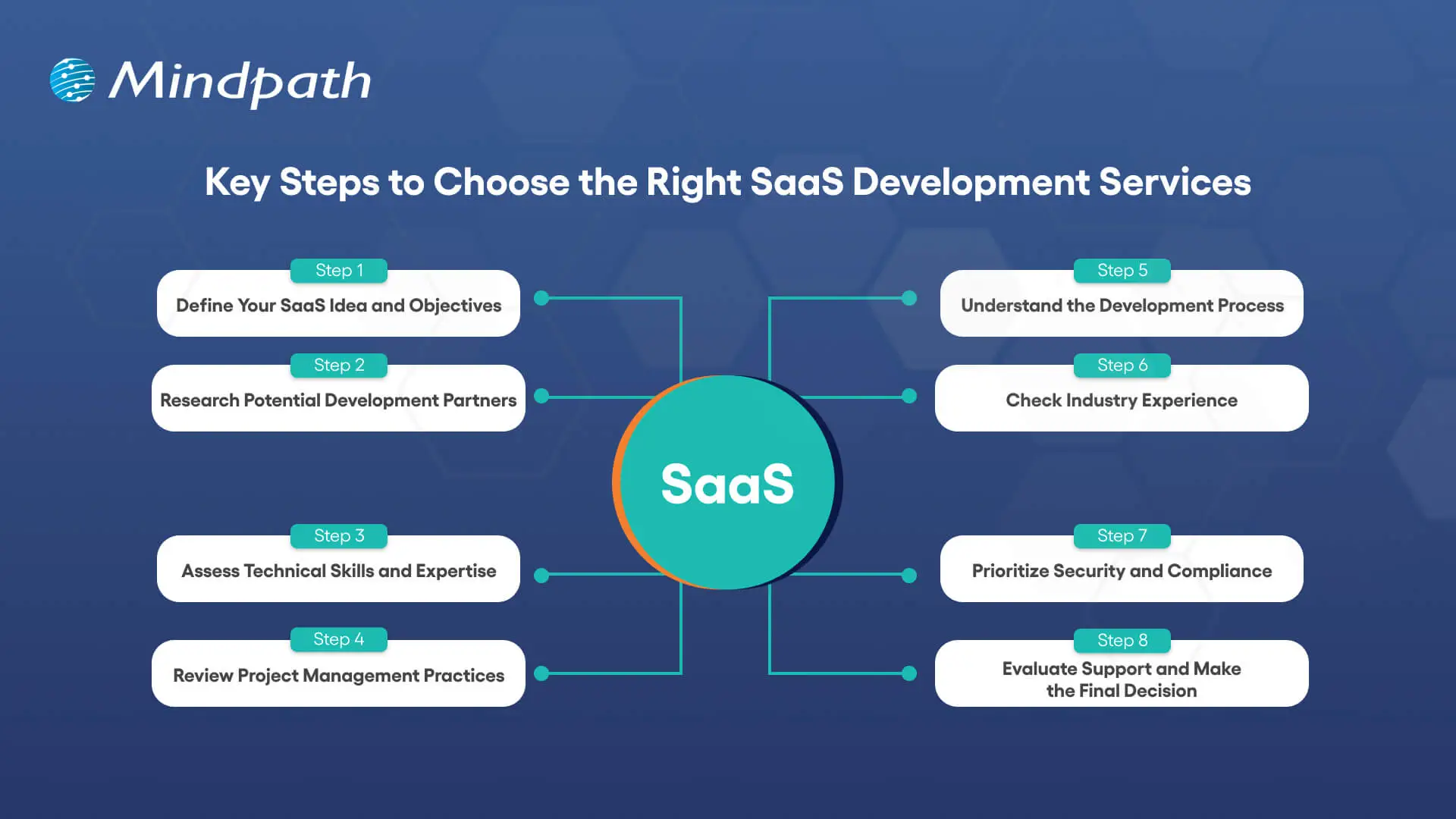
Key Steps to Choose the Right SaaS Development Services

The choice of SaaS development services requires a clear idea, planning, and business orientation. The most important steps to selecting SaaS application development services that facilitate long-term growth are as follows.

Key Steps to Choose the Right SaaS Development Services

1. Define Your SaaS Idea and Objectives

Be clear about your SaaS concept, what problem it will address, and who your audience will be. Clear goals contribute to the alignment of attributes, functionality, and business objectives in the long run. This transparency enables the SaaS development services to create a product that is focused and efficient.

2. Research Potential Development Partners

Begin by doing research on credible SaaS development companies that have a successful track record with SaaS projects. Check their portfolios, case studies, and feedback from clients to determine credibility. This study can assist you in narrowing down partners who can provide scalable solutions.

3. Assess Technical Skills and Expertise

Evaluate the technical competence of the in-house development team in the front end, back end, and cloud computing. Ensure that they know the process of developing secure and scalable SaaS applications. Well-developed technical capabilities reduce the development risks and improve the overall performance of the product.

4. Review Project Management Practices

Understand how the company manages schedules, work and communication in the development process. Agile project management is flexible and responds more rapidly to changes. Analytical thinking will ensure consistency and quality in development.

Must Read: SaaS Challenges for Businesses

5. Understand the Development Process

Inquire about their entire development cycle such as designing, testing, and implementation. Make sure that security and performance, as well as scalability, are considered at an early stage. A trusted Saas development platform enhances easier cooperation and implementation.

6. Check Industry Experience

Experience in the industry helps teams to know more about your business challenges. Experienced developers are able to foresee risks and recommend workable improvements. This results in improved custom SaaS development projects.

7. Prioritize Security and Compliance

Make sure that the development team has good security standards and compliance requirements. The process of development should include data protection and compliance with regulations. This ensures the safety of user information and builds up confidence in the product.

8. Evaluate Support and Make the Final Decision

Evaluate the capacity of the company to offer long-term support and maintenance. Constant improvement and interaction are key to successful products. Select SaaS development services, which reflect your growth plans and vision.

Want to stay ahead in the competitive market by understanding how SaaS is evolving? Discover our guide on SaaS trends to explore the latest innovations shaping the future of the industry.

Ready to Transform Your Business with SaaS?

Selecting the appropriate SaaS development services will keep your company competitive, scalable and efficient. Successful SaaS products are the result of clear planning, technical expertise and strong project management. Using systematic steps assists in choosing partners who provide secure, reliable and innovative solutions. Having the right team ensures your software keeps up with the business requirements and enhances performance and user satisfaction.

At Mindpath, we provide professional custom SaaS development services based on your business objectives. We are a team of prolific developers and present scalable, secure, and user-friendly solutions. Our priorities are innovation, a smooth partnership, and continuous support to achieve optimal performance of your SaaS product. Mindpath is the choice that ensures a future-proofed platform that is designed to expand with your users and business vision.

Digital Twin technology

Manufacturers all over the world have been under pressure to meet emerging challenges in an environment with limited resources. The prominent setbacks for the manufacturing industry include supply chain shortages and talent gaps. However, the advent of digital twin technology serves as the best example of how technological innovation can shape the future of manufacturing. Digital twins can not only enhance capacity but also ensure more efficiency and resiliency in manufacturing operations.

The growing demand for fast-paced and continuous operations in manufacturing creates various limitations. Digital twins offer virtual representations of production lines, equipment or the whole factory to help manufacturers with more effective decision-making. Manufacturers must know about the utility of digital twins and how they can unlock untapped value to prepare factories of the future.

Looking to harness digital twin technology to gain deeper insights and future-proof your business? Contact us for expert guidance and tailored solutions that help turn digital twin innovation into real-world impact.

Understanding the Digital Twin Technology

The foremost highlight in any introduction to digital twins will focus on their definition. The most common answers to ‘what is digital twin technology’ paint them as virtual representations of physical objects or systems. Digital twins use real-time data to imitate the behavior, conditions and performance of their physical counterparts. Digital twins help with continuous monitoring and analysis of objects, systems or products throughout their complete lifecycle. In addition, digital twins can also feature external processes and crucial variables that can influence the performance of real-world assets.

One of the significant highlights of digital twins is that they work with data flowing between the object and its virtual representation in real-time. The two-way flow of data ensures the most accurate simulations of the physical world. Businesses can also use multiple digital twins together to create models for more complex systems, aimed at a larger digital transformation strategy.

Digital twins provide a clear impression of how something works and predicts its behavior in future scenarios. As a result, they can help in accelerating innovation and improving efficiency along with making well informed decisions. You can come across use cases of digital twins in predictive maintenance, product development, supply chain optimization and process optimization.

Breaking Down the Architecture of Digital Twins

If you want to capitalize on the power of digital twins in diverse use cases, then it is important to know their architecture. You can find digital twin providers like IBM, Microsoft, General Electric and Siemens with solutions that provide a comprehensive suite of services. The digital twin examples may feature hardware layers, synchronization services, data processors and other tools to draw the most accurate simulations of real objects and processes. However, awareness of the architecture of digital twins can help you figure out exactly what you need to make the most of the innovative technology.

1. Physical Asset

The physical asset in digital twins can be any real-world object, process or system that you want to study or monitor within virtual environments.

2. Virtual Model

The virtual model in digital twins is the digital representation of the physical asset that you want to know more about.

3. Data Sources

One of the notable highlights in the answers to ‘what is a digital twin’ points at the two-way flow of data between the physical asset and the virtual model. Data sources are an integral component in digital twin architecture as they ensure accuracy in virtual representations. Internet of Things or IoT devices serve as data sources by recording relevant metrics for creating digital twins.

4. Data Pipelines

Data pipelines are used for transmitting sensor data to the virtual model in real time. They play a vital role in ensuring that the digital twin is synchronized with the physical asset.

5. Feedback Loop

The feedback loop helps in sending control signals or insights from the virtual model to the physical asset. It serves as a promising component for optimizing performance and efficiency alongside enhancing decision-making.

6. Analytics Engine

Digital twins needs an analytics engine running on AI or machine learning to detect patterns and facilitate predictive analytics. The functionalities of the analytics engine helps in drawing accurate simulations alongside offering support for effective asset tracking.

7. Visualization Dashboard

The visualization dashboard is another crucial component that completes the digital twin definition by providing access to the virtual representation. You can use the visualization dashboard to interact with the two-dimensional or 3D representation of the physical asset.

Breaking Down the Working Mechanism of Digital Twins

The uses of digital twins can vary by huge margins across different industries and applications. You must also know that digital twins follow some common steps that you will find in every example.

1. Data Collection

Organizations can start their digital twin projects by embedding sensors on a physical object to capture its performance, operating environment and condition. The digital twin meaning in case of IoT applications revolves around using smart objects that feature in-built sensors to collect and share data continuously. In the case of IT environments, teams can create digital representations of computers, applications and software with virtualization technologies. Subsequently, the teams can use software agents to collect data from the digital asset for supporting the digital twin.

2. Creation of the Virtual Model

The primary focus of digital twins aligns with the creation of digital replicas of certain objects or systems. Virtual modeling involves using the data collected from the physical asset to create a digital model. It is important to define digital twins with key attributes that help them offer realistic reactions to variables. The variables can refer to interactions with the physical asset or its environmental conditions. The attention to virtual modeling ensures that digital twins can offer reliable and accurate simulation of the responses of the physical assets in different conditions.

3. Real-Time Data Integration

You cannot think of a digital twin without live data integration as it ensures continuous communication between the digital twin and physical asset in real time. Live data integration offers a dynamic feedback loop that can help organizations with performance optimization and enhancements in system reliability. The two-way data exchange also helps in efficient predictive maintenance by anticipating issues ahead of time. Most of the organizations automate the real-time data exchange process to focus on more critical and strategic tasks.

4. Analysis and Decision-Making

Digital twins offer the most promising solutions to experiment safely within virtual environments. You find better answers to ‘how do digital twins work’ in manufacturing plants where digital twins can help in finding out how an upgrade may affect efficiency and performance. The best thing here is that manufacturers don’t have to implement the upgrade directly to measure its impact. On top of it, analytics engines used in digital twins can recommend operational changes to make the changes more cost-effective.

Variants of Digital Twins

Most of the discussions about digital twins don’t emphasize the fact that you can find different types of digital twins. Organizations can deploy different variants of digital twins in one production environment with the advantage of learning from different levels of physical assets.

1. Product Twins

Product twins refer to the virtual representations of products after the ideation stage or throughout the complete lifecycle. You can use product digital twins for design improvements, enhancing service satisfaction and manufacturing efficiency.

2. Process Twins

The variety of digital twin applications also draws attention towards the use of process twins that help in understanding how different systems work with each other. Process twins offer visualization of the interactions between systems and suggest actionable feedback to improve quality standard or process speed.

3. Part Twins

Part twins or component twins focus on the most granular level of larger systems. The primary goal of part twins revolves around measuring the insights from basic components of larger systems. Component twins serve a promising role in understanding the performance of certain components and identifying larger problems before they happen.

4. Place Twins

The largest deployment of digital twins can happen in the form of place twins. You can find examples of place twins in factory twins, which simulate a complete physical location or place. In some cases, you may assume similarities between process twins and place twins. However, place twins also include spatial data, such as climate, context and temperature of the physical location.

Unraveling the Use Cases of Digital Twins

Organizations in different industries leverage digital models to understand complex systems and promote innovation. Digital models have also proved as the most useful tools for efficient optimization and predictive equipment maintenance. You can find a digital twin use case in almost every major industry with widespread applications.

1. Construction of Physical Structures

Digital twins can prove to be the most useful tools for engineers to design durable and safe physical structures, such as buildings, bridges and dams. For example, digital twins can help engineers determine whether a specific design for a bridge can enhance its durability. As a result, engineers can identify any setbacks and make changes in the design before starting construction.

2. Healthcare

Another promising area where digital twins can offer significant advantages is in the domain of healthcare. Digital twins can come up with crucial insights from forecasts of disease progression to identify how patients will respond to different treatment options. Furthermore, healthcare professionals can use digital twins to enhance diagnosis through detailed modeling that helps in understanding how interactions between organs can affect health.

3. Urban Planning

You can also notice the benefits of digital twins in urban planning applications, especially for traffic supervision. City models use spatial data, IoT object data and AI analytics to determine how new transportation systems or infrastructure upgrades will affect the city’s environment and traffic. Digital twins serve a pivotal role in planning for smart cities and urban planning experts aim to tap into their power to enhance sustainability and quality of life.

Identifying the Advantages of Digital Twin Technology

The use cases of digital twins across different industries reveal their potential to revolutionize digital transformation. You can notice how digital twins offer more visibility into complex systems while opening doors for experimentation without real-world changes. An overview of their advantages can help you understand how they can unlock the future.

1. Faster Research and Development

How do you think a business can step into the future ahead of time? Without research and development, companies cannot experiment with new product designs, manufacturing processes or workflows. The advantages of digital twins make it easier to experiment within a virtual environment, thereby opening the doors for accelerated innovation. Digital twins offer a more cost-effective and safer approach to research and development without the need for real tests.

2. Scalability

Companies can stay competitive in the modern business landscape only by adapting to changes in product demand, customer priorities and economic conditions. Digital twins offer virtual environments where you can adjust parameters and test configurations safely before full-scale deployment. You can also connect digital twins to live systems and ensure that they can continuously transmit their scaling adjustments in real time to the physical asset.

3. Operational Efficiency

The next crucial outcome of digital twin technology is the assurance of enhanced operational efficiency. Digital twins can provide the insights required to achieve operational efficiencies throughout the value chain. Organizations can use different datasets to collect real-time data on physical asset and production performance. With more visibility into the asset or process bottlenecks, digital twins can help in crafting potential solutions.

Final Thoughts

The progressive use of digital twins is a perfect example of how the world is welcoming innovation and preparing for the future. Digital twins provide the easiest solution to multiple problems that affect efficiency, cost-effectiveness and productivity in different industries. With the help of virtual models that mimic real-world assets, companies can reinvent their manufacturing, services and internal management.

Mindpath is one of the leading destinations for digital twin app development with years of expertise in end-to-end IT solution development. We are proud to have team members who are eager to learn and specialize in new technologies, including digital twins. Our experts are familiar with the use of popular tech stacks for digital twin development in alignment with your business goals. Consult with our team and build your first digital twin right now.

Discover how digital twin technology boosts efficiency, enhances product quality, and supports sustainability. Learn its impact on modern businesses and industry sectors.

Support Is One Click Away

Featured Posts

Related Post