How Much Does a Website Development Cost in 2026 

Home

How Much Does a Website Development Cost in 2026 

How Much Does a Website Development Cost in 2026 

Join our Newsletter!

Website Development Cost

It may sound easy to create a site in 2026, yet one must be very careful with planning. The web development cost is a topic that can cause a real debate between business owners and project teams. People desire to make a good investment. Although a budget is significant, the ultimate outcomes must be considered first. The overall cost is dependent on the design, features, and future needs. Having experience in a tech-expert company, we observe that people tend to stop at this point and reconsider themselves. Such a break enables them to become wiser with digital decisions.

In fact, knowing the cost is not just a matter of money. It is a matter of aligning your idea with the appropriate solution. Companies nowadays require speedy websites that can develop without any problems and remain safe. The prices are being influenced by these demands gradually. However, the latter still goes on changing because of new tools and trends. This puts cost planning at a higher level than before. So, in this blog, we explain what shapes website development prices in 2026 and how to plan them clearly.

Want a website that works effectively for your business without exceeding your budget? Mindpath’s web development services create tailored solutions that are reliable, scalable, and affordable.

Why Cost Matters While Creating a Website?

Cost planning determines the degree of strength of your website, and it influences all decisions. Website development cost directly dictates the quality of design, functionality, security, and user experience, and ultimately your site’s conversion rate. An effective budget allows one to employ talented professionals and prevent poor growth. It also helps avoid hidden fees and expensive redesigns caused by poor performance or technical downtime. Webpage development cost also includes hosting, tools, and testing. A combination of these components forms a site that can support business objectives and generate long-term value.

The site also requires routine maintenance to continue to be useful after launching. Web development service costs involve updates, security checks, and performance improvements. These measures make the site stable and reliable. A preplanned budget also regulates the alterations in features and averts unnecessary costs. You can monitor the leads and sales with proper cost planning. This enables the site to be a powerful, quantifiable business resource.

Want to avoid unexpected website development costs? Check out the web development roadmap to understand project milestones and cost drivers.

Factors Influencing Website Development Costs in 2026

Website expenses in 2026 are based on a combination of various intertwined aspects that will inform the course of planning decisions. Webpage development and website design cost makes businesses understand how to establish a realistic budget early.
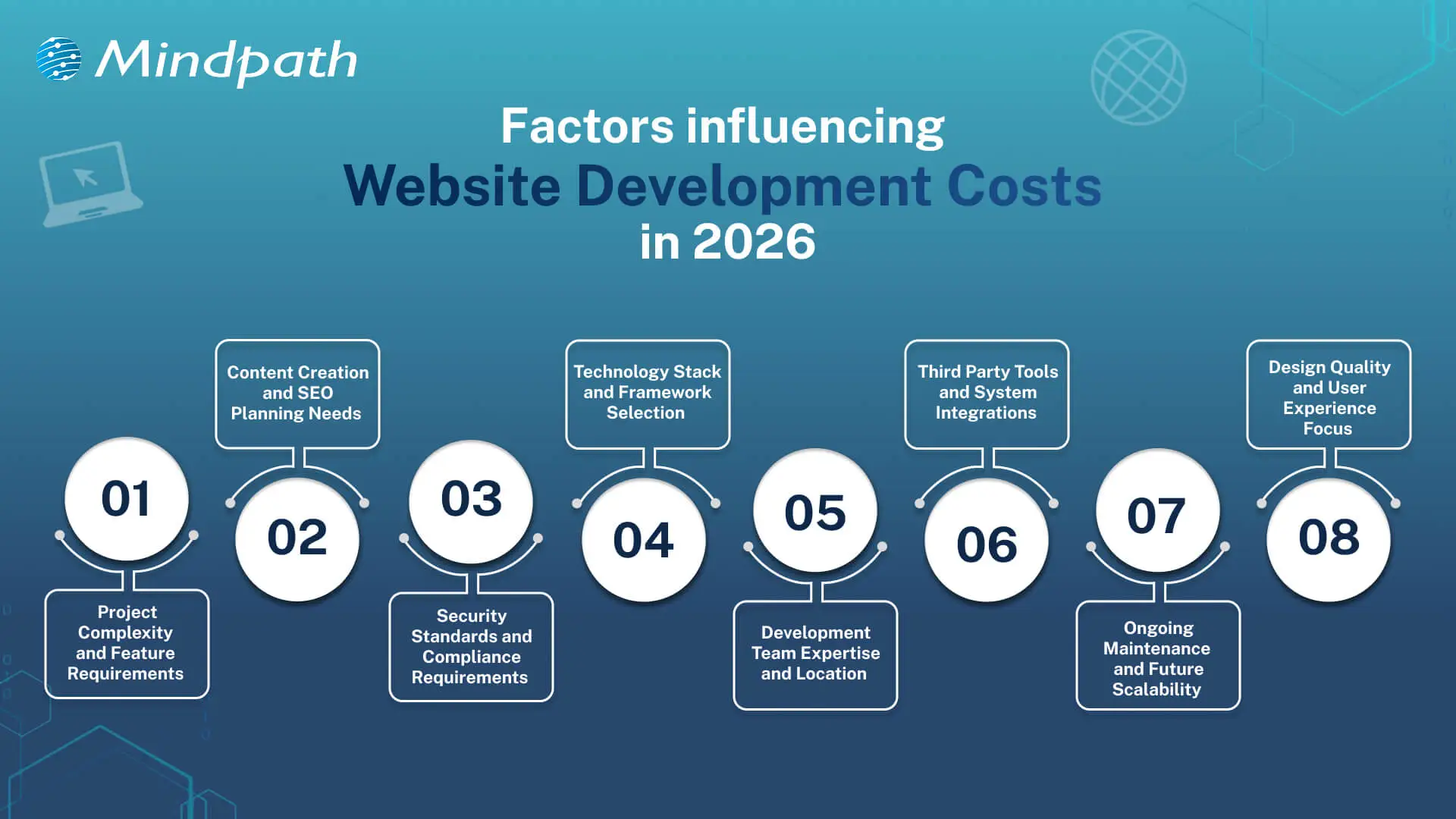
Factors Influencing Website Development Costs in 2026

1. Project Complexity

Basic websites are inexpensive and will satisfy fundamental requirements. The inclusion of more specific features like e-commerce or user accounts complicates and adds more planning. All these additions increase the average website development costs.

2. Content and SEO Requirements

Excellent content is advantageous to the user and the search engines. Establishing the SEO takes serious planning and technical effort. This increases visibility but increases the budget.

3. Security and Compliance Needs

Secure websites save the data of users and maintain the reputations of the business. Compliance regulations impose additional development phases, which introduce relevant layers of costs.

4. Technology Stack Choices

The contemporary tools determine the strength of a web site. It is time-consuming to work with AI, AR, and sophisticated frameworks. This option has a powerful influence on the website development costs.

Curious why some web projects cost more than others? Discover web development tools and see how technology choices influence productivity and expenses.

5. Development Team and Location

Expert teams provide scalable and stable websites. Compared to freelancers, agencies are more expensive due to their wider knowledge. Location is also a factor that affects rates and total expenditure.

6. Third Party Integrations

Websites usually have a connection with payment or CRM tools. Additional setup and testing time is added in every connection. An increase in integrations implies increased development effort.

7. Maintenance and Scalability

Websites need updates after launch. Hosting, fixes, and growth planning require steady investment. These costs support long-term performance and ROI.

8. Design and User Experience

Good design improves trust and user flow. Custom layouts need research and testing across devices. This work increases value and raises the average website development cost.

Looking to understand how emerging trends affect website development costs? Check out the latest web development trends to see how new technologies and practices influence project scope.

Understanding Website Development Costs

Website development costs depend on planning, technology, and business goals working together. Understanding these costs helps businesses make smart decisions before starting development.

1. Enterprise Website

The cost usually starts from £50,000 and can exceed £150,000 based on scale. Pricing increases due to security, integrations, and multi-language requirements.

2. Single-Page Website

Costs typically range between £250 and £800 for a basic setup. The price stays low because development time and features remain minimal.

3. Custom Web Platform

These platforms cost between £15,000 and £75,000 or more depending on logic. Higher costs reflect custom development, testing, and long build cycles.

Curious how web development costs compare to full-scale software projects? Discover software development cost insights to understand long-term budgeting and investment planning.

4. Small Business Website

The average cost falls between £800 and £3,000 for 5 to 10 pages. Pricing depends on CMS use, design level, and basic SEO setup.

5. E-Commerce Website

Costs usually start around £2,500 and can exceed £20,000. The final price depends on products, payment systems, and inventory complexity.

6. Advanced Brochure Website

Pricing ranges from £3,000 to £8,000 for custom design builds. Costs rise due to animations, performance hosting, and lead-focused features.

Planning your web development budget more effectively? Explore web development technologies to see how choosing the right stack affects cost and performance.

Ready to Plan Your Website Budget with Confidence?

Planning a website in 2026 needs clarity and smart thinking. Costs connect with design, features, security, and growth plans. Website development costs change with every decision you make. Clear planning avoids confusion later. It also helps balance value and spending. When you understand web development pricing, you invest with purpose and confidence.

Mindpath web development services focus on clarity, quality, and growth. Our teams plan projects with clear goals and transparent charges for website development. We build secure, scalable websites that support real business needs. Every solution balances performance and cost. With Mindpath, planning stays simple and results stay strong.

Related Post

full stack development benefits

In our fast-paced digital world, businesses are seeking better and smarter solutions for their digital presence. One proven method is embracing full-stack development benefits to handle both visual and functional components of web and app development projects. Full-stack development enables a company to be more responsive to market demand and build a seamless overall digital experience. One approach to ensure you are keeping up and growing with the pace of technology is to study full-stack development for long-lasting success.

By combining front-end and back-end development in one united team, it serves to harmonize your collaboration and streamline your processes. When one team completes the entire process, it enables faster turnarounds, greater risk control, and cost savings. Full-stack development is a workable option whether you’re a startup or a large organization looking for an efficient way to scale. In this blog, we’ll explore how full-stack development can bring these advantages to your business. So, let’s dig in!

Want to use full-stack development benefits in your business? Mindpath’s full-stack development services will help you in designing an effective way to scale your business.

What is Full-Stack Development?

Full-stack development is the complete process of building a web application from beginning to end, including both the client-side and server-side aspects. Full-stack developers will work with front-end technologies like HTML, CSS, and JavaScript, as well as back-end technologies such as Node.js and PHP, or Ruby on Rails. They deal with the interface that the user sees, as well as the server-side logic that operates behind the scenes as it interacts with APIs and databases.

A full-stack developer is comfortable working on both front-end and back-end development, which means they can handle the entire application lifecycle. They write code, test and deploy that code, and interact with databases. They often integrate third-party services into their applications as well. These professionals know how each layer of the web application connects, from the user interaction to processing data. Their variable skill set makes them important in a team setting where communication is essential between the layers, specifically for performance, scalability, and maintenance.

Explore: Full-stack vs traditional web development 

Key Components of Full-Stack Development

Getting an idea of the major components of full-stack development for business is necessary for creating effective and scalable digital products. These different components ensure that each piece of the application operates seamlessly together.

Key Components of Full-Stack Development

1. Front-end Development

Front-end development focuses on building the user interface using technologies like HTML, CSS, and JavaScript. It ensures that users can interact smoothly with the application through a responsive and visually clear layout.

2. Back-end Development

Back-end development handles the server-side logic, managing tasks like database operations, server communication, and authentication. Developers use languages such as Python, Java, or Node.js to ensure that the core application functions run efficiently.

Looking for an effective way through which you can build scalable applications? Discover how full-stack development with Node.js can enhnace your business growth.

3. API Development

API development allows applications to communicate with each other by creating structured pathways for data exchange. One of the full-stack development benefits is the ability to build and manage APIs that integrate various services into a single application.

4. Database Management

This involves designing and maintaining structured databases using systems like MySQL, MongoDB, or PostgreSQL. Efficient database management is key to ensuring secure data storage, fast retrieval, and overall system reliability.

5. Version Control

Version control helps teams manage code changes and collaborate effectively using tools like Git. It keeps track of every update, allowing developers to maintain stability, fix bugs quickly, and work on features without conflicts.

Full-Stack Development Benefits for Businesses

Many businesses today are choosing full-stack development to streamline their digital projects and improve overall efficiency. Here are some key advantages of full-stack development for businesses that highlight why this approach is gaining popularity across industries.

full stack development benefits for business

1. Faster Project Delivery

One of the key full-stack web development advantages is faster project completion, as the same team handles both front-end and back-end tasks. This reduces delays caused by waiting on separate teams and keeps the development flow going smoothly. With better collaboration and fewer hands-off, businesses can launch products more quickly and efficiently.

2. Cost-Efficient Solution

Hiring freelance Full-stack developers helps cut costs by handling the entire development process without needing multiple experts. This simplifies team structure and lowers overall development expenses. This business benefit of full-stack developers is especially valuable for startups and growing companies with limited budgets.

3. All-in-One Development Approach

Full-stack developers have the skills to manage every layer of a web application, including frontend, backend, and databases. Their broad knowledge allows them to build efficient, stable, and well-integrated solutions. This results in fewer errors, faster development, and a smoother launch process.

4. Adaptability to Modern Technologies

Full-stack development benefits include staying aligned with evolving technologies like AI, machine learning, and modern web frameworks. Developers apply the right tools to build responsive, feature-rich applications that match today’s user expectations. Their up-to-date knowledge of full-stack development trends supports faster innovation and long-term system improvements.

5. Post-Launch Support

Full-stack development benefits businesses by offering complete support even after the product goes live. Developers can manage updates, fix bugs, and maintain both frontend and backend systems efficiently. This ongoing support ensures long-term stability and performance for digital applications.

6. Centralized Project Control

Full-stack developers take full responsibility for the entire codebase, covering both front-end and backend. This avoids delays caused by switching between separate teams and helps solve issues faster. With complete control, the development process stays organized and efficient.

Also Read: Full-stack Development for Web Projects.

Business Use Cases of Full-Stack Development

Full-stack development offers flexible solutions that fit a wide range of business needs. Here are some practical use cases where this approach adds value across different industries and project types.

1. Enterprise Applications

Companies use full-stack development to build scalable enterprise tools that support internal workflows and boost productivity. These applications can connect departments, automate tasks, and improve overall business performance.

2. Content Management Systems (CMS)

With full-stack development, businesses can create flexible CMS solutions tailored to their content strategies. These systems make it easier to manage digital assets, add SEO tools, and track performance through built-in analytics.

3. Real-time Applications

Applications like messaging platforms and live dashboards rely on real-time data updates and user interactions. Full-stack development benefits these projects by ensuring fast communication between front-end and back-end components.

4. E-commerce Platforms

Full-stack development supports building responsive and secure e-commerce websites with integrated features like product search, payments, and user accounts. It allows businesses to deliver a seamless shopping experience while managing inventory and customer data effectively.

5. Big Data and Analytics Platforms

Businesses use full-stack development to build platforms that handle and visualize large volumes of data efficiently. Full-stack development benefits these solutions by enabling the smooth integration of data processing, analysis tools, and user-friendly dashboards.

Curious about how different developer roles can transform your business needs?? Explore our detailed blog on front-end vs back-end vs full-stack.

Looking to Scale Smarter with Full-Stack Development?

Full-stack development benefits help businesses simplify workflows, reduce costs, and build stronger digital solutions. With complete control over the front-end and back-end, it brings speed, flexibility, and long-term support. From e-commerce platforms to real-time apps, full-stack development continues to be a smart choice for businesses aiming to stay competitive in a fast-changing digital world.

At Mindpath, we offer expert full-stack development services tailored to your business needs. Our skilled team brings deep technical knowledge, reliable support, and fast delivery. If you’re ready to hire full-stack developers who deliver results, we’re here to help you scale with confidence.

Frequently Asked Questions

1. What are the real full-stack development benefits for a business that is just starting out digitally?

For early-stage businesses, the biggest advantage is simplicity. One team handles everything, which means fewer miscommunications, lower costs, and faster launches. You get a working product without the complexity of managing separate frontend and backend teams pulling in different directions.

2. How does full-stack development actually save money compared to hiring separate specialists?

When one developer or team handles both sides of a project, you eliminate handoff delays, reduce coordination overhead, and cut hiring costs. For businesses watching budgets closely, that efficiency adds up significantly across the entire development timeline.

3. Is full-stack development a good fit for complex projects, or does it work better for simpler builds?

It works well across both. Simpler projects benefit from the speed and cost savings. Complex ones benefit from having developers who understand how every layer connects, which reduces integration issues and makes troubleshooting far more efficient when problems arise.

4. What happens when a full-stack developer is not familiar with a newer technology the project requires?

This is worth asking upfront. Good full-stack developers are generally adaptable and quick learners, but verifying their experience with specific frameworks or tools before starting a project saves a lot of time and avoids rework later.

5. How do you decide between hiring a freelance full-stack developer versus working with a development company?

Freelancers suit smaller, well-defined projects with tight budgets. A development company brings team depth, accountability, and long-term support. For anything requiring ongoing maintenance, scaling, or complex integrations, a structured team is usually the more reliable choice.

Web development technologies

If you think that web development is all about building a website, you are wrong! Web development is more about creating a scalable, intelligent digital experience that can help businesses convert visitors into loyal customers. In 2026, new web development technologies are changing how web apps and websites are developed and scaled, unlocking more engagement, efficiency, and growth potential. 

Whether you are an enterprise or a startup, here are the top website development technologies that would play an important role in your business growth in 2026. 

Looking to unlock new possibilities by integrating the latest web development technologies into your business? Partnering with Mindpath Web development services will offer you professional expert guidance on how to implement these technologies for your business growth.

What are Web Technologies?

Before exploring the latest web development technologies, let’s understand what it means. Web technologies are the tools, protocols, languages, and frameworks used to create as well as maintain websites and web apps. They include everything like front-end and back-end technologies, Web APIs, full-stack technologies, performance optimization tools, and more. 

Leveraging the right set of web development tools and technologies is crucial to creating a fast, scalable, and secure website that can support business growth. 

Major Technological Trends to Consider in 2026

A number of overarching web development trends are significantly shaping the process of web development. These are: 

1. Technologies and web development practices that focus on efficiency and speed will be important.

2. Accessible, engaging, and intuitive interfaces are necessary to retain users and drive conversions.

3. Businesses are looking for solutions that can grow with them, easily accommodating expanding features and increasing traffic. 

4. Customizing experiences for users through machine learning and AI will become a necessity for businesses. 

5. Businesses would focus more on sustainable web development practices. 

With these key trends in mind, let’s explore the vital web development technologies that every business should consider in 2026. 

Need solutions tailored to your business requirements? Explore more about custom web application to see how personalized apps improve performance and engagement.

Key Web Development Technologies List

Staying updated with the latest web development technologies is crucial for crafting websites and web apps that are flexible, future-ready, and fast. Here is a list of pivotal technologies shaping the process of web development. 

1. Machine Learning and Artificial Intelligence

While creating the top web technologies list, it would be wrong to avoid machine learning and AI in web development. AI-powered tools are automating various web development processes, like coding and testing. Besides, these tools also help streamline content generation and boost user personalization. 

On the other hand, Machine Learning models and libraries such as Scikit-learn, TensorFlow.js, and PyTorch help make a website capable of real-time analytics and more adaptive. As a result, businesses can now make intelligent/informed decisions. 

2. Headless CMS Architecture

Headless separates the front-end from the back-end. This allows developers to utilize modern programming languages, tools, and frameworks to develop customized websites and apps that perform smoothly across different platforms. 

With the help of tools such as GraphQL and WordPress REST API, WordPress’s capabilities can be combined with advanced front-end technologies such as Next.js, Vue, and React. 

3. Progressive Web Apps

Progressive Web Apps or PWAs combine mobile and web experiences, enabling seamless performance, push notifications, and offline access to enhance user engagement as well as retention. PWAs can be installed from the browsers; users don’t need to use app stores for this. Furthermore, these apps utilize HTTPS or TLS for data exchange to keep data secure. 

4. Jamstack

Jamstack combines JavaScript, APIs, and Markup together, allowing developers to separate front-end and back-end. This web development architecture ensures quick load times, improved SEO, robust CDN distribution, and higher security. This can be used for content-heavy websites, service booking platforms, or landing pages. 

Also Read: Application Security Best Practices for Web and Mobile Apps

5. Edge Computing and Serverless Platforms

Serverless platforms such as Oracle Cloud Functions, AWS Lambda, and Microsoft Azure allow the creation and deployment of web solutions without managing infrastructure. While using these platforms, developers just need to focus on writing code, and the cloud service providers will handle tasks like server provisioning, maintenance, scaling, etc. 

Edge computing helps bring processing near to the sources, significantly reducing latency and cost while improving privacy, security, and other features for businesses. 

6. HTMX

It allows developers to create dynamic web interfaces utilizing HTML attributes, lowering the use of heavy JavaScript frameworks. HTMX simplifies the development process and makes web apps offer faster performance. It can be an excellent option while developing form-heavy web apps, admin dashboards, and internal CRMs. 

7. WebAssembly

WebAssembly, or Wasm, allows browsers to run high-performance code like Rust and C++ at high speed. This means heavy or complex computations, such as video editing, gaming, cryptography, and 3D rendering, can now be done on the web. It is an ideal option for interactive learning platforms and simulation tools. 

8. Motion UI

Using motion UI frameworks, it is possible to animate interfaces. Businesses can boost user engagement through smart navigation cues, dynamic transitions, polished visual effects, and more. In short, motion UI elevates the intuitiveness and appeal of your websites and web applications.  

Want to build faster and dynamic websites? Check out our ReactJS Web Development Guide to learn how ReactJS powers modern web apps.

Most Popular Web Development Frameworks For 2026

Here is a table of the most popular web development frameworks businesses must adopt for a successful web development process. 

Front-end Technologies (List)

FrameworkKey FeaturesIdeal For
Tailwind CSS Rapid prototyping and utility-firstLanding page and modern UI
ReactVirtual DOM, and reusable componentsInteractive dashboards, SPAs
Vue.jsFlexibility, reactive components, and lightweightSmall to medium-sized web applications
Next.jsReact-based, SSR, API integration, and routingScalable and SEO-friendly platforms
SvelteCompact code, fast, and no virtual DOMLightweight web applications
FramerMotion, and AnimationDynamic and engaging UI
ViteA huge plugin system, TypeScript support, and CSS processingSmall to large web applications

Back-end Technologies (List)

FrameworksKey FeaturesIdeal For
LaravelMVC, PHP, and elegant syntax APIs, CMS, and e-Commerce
Node.jsJS on server, and non-blocking I/OReal-time web apps and APIs
Express.js Minimalist Node.js, performant, and cleanMicroservices and APIs
SupabaseOpen-source, REST API, branching, and custom domainData-driven and scalable web applications
Ruby on RailsConvention over Configuration, active record, dynamic data magic, and scaffoldingWeb platforms and MVPs
GoScalable, fast, and concurrencyAPIs and microservices
Spring BootJava-based, auto-configuration, command line interface, and externalized configurationLarge-scale and enterprise-grade web apps

Want to boost your website’s speed and scalability? Learn about web performance with Node.js to see how it powers web applications.

Why Businesses Should Embrace New Web Development Technologies?

Modern web development plays a vital role in shaping the way businesses interact with their customers. It can influence market share, conversion rates, operational efficiency, and engagement. However, some significant advantages of using new technologies in web development are: 

1. PWAs, motion design, and voice UIs can make the digital experience for users more memorable. 

2. APIs and the use of low-code platforms mean businesses can launch new products and features quicker than ever. 

3. Fast-loading web architectures like Jamstack or AMP and semantic code lead to improved visibility, increasing the reach.

4. Blockchain and serverless platforms make it easier to handle global users as well as business compliance. 

To witness these benefits, businesses should have a solid plan regarding the adoption of these web development technologies. Check out the section below to know more. 

Planning a web app as part of your technology strategy? Check out our web app development roadmap blog to understand each stage for building scalable and efficient applications.

How to Adopt These New Web Development Technologies?

If you are considering using these new web development technologies, then here are some tips to keep in mind to make the process hassle-free.

1. Ensure that the technology you want to use can support your business growth.

2. Choose one that offers enough documentation, resources as well as community support. 

3. Check whether the new technology will work well with your existing tools. 

4. Verify whether it meets data protection and compliance needs. 

5. Ensure that the new tool can help boost speed, UX, UI, and accessibility. 

6. While choosing between proprietary and open-source technologies, consider the cost factor and capabilities of both technologies. 

Want your web applications to be user-friendly and engaging? Read our UI/UX Design Trends blog to learn design practices that enhance usability and retention.

Creating a Course for Digital Dominance

Well, it is quite clear that businesses in 2026 must consider web development not just as a functional need, but as a crucial element for growth and innovation. With the help of the web development technologies list outlined above, businesses will be able to position themselves to engage with their customers effectively, innovate, and streamline their processes while supporting substantial growth. 

This is where Mindpath comes in. With a team of experienced and certified developers and a successful track record in creating dynamic and responsive websites, Mindpath empowers organizations through its web development services to translate their visions into digital reality. Besides, we leverage cutting-edge web development technologies. We understand the latest web development trends and can help you make informed technological decisions so that you can maintain your digital dominance. 

If scaling your digital presence and attaining measurable growth is your goal, Mindpath brings a perfect combination of skills, innovation, collaboration, and strategy to convert your vision into results. Begin your journey to a successful digital transformation in this evolving digital landscape with us! 

Support Is One Click Away

Featured Posts

Related Post

Discover the ultimate guide to hiring Node.js developers in London. Learn about the skills, benefits, and cost factors involved in finding the right talent for your project.